
In many LED headlight advertisements, we often see claims such as “multi sided lighting”, “more LED chips”, or “ultra high lumens”. However, for wholesalers, distributors, and professional buyers, judging the quality of an LED headlight should not be based only on the number of chips.
What matters more is the chip size, chip quality, substrate structure, thermal path, driver stability, and final beam pattern.
In this article, we are going to explains what an LED chip is, what key parameters are related to LED chips, and what buyers should pay attention to when sourcing LED headlight products.
What Is an LED Chip?
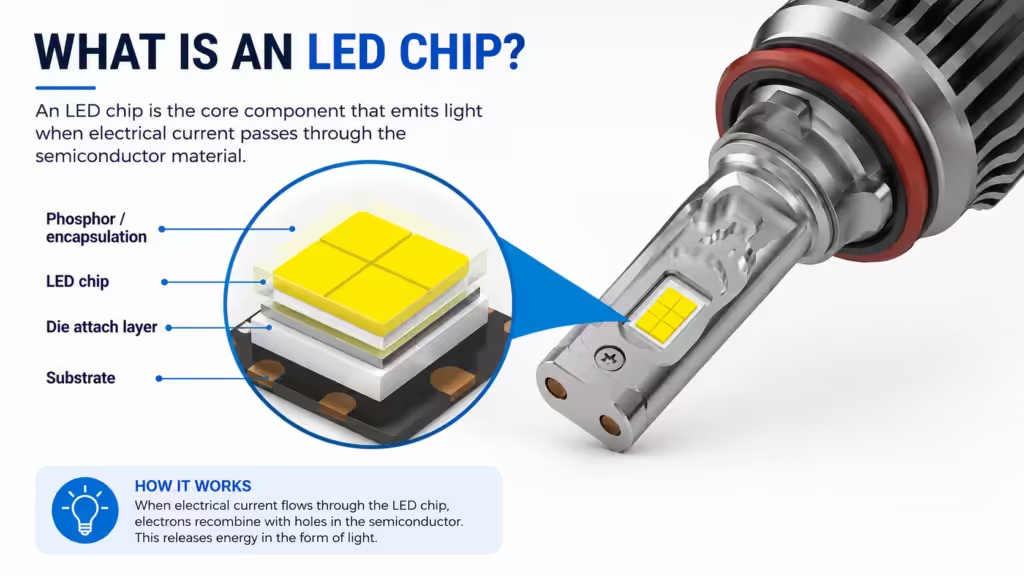
An LED chip is the core part of an LED light source. It is the component that actually emits light. When electric current passes through the semiconductor material inside the LED chip, electrical energy is converted into light.
In a complete LED package, the chip does not work alone. It is mounted onto a conductive and heat transferring structure, then combined with phosphor, encapsulation materials, lenses, or other optical structures to form a complete LED light source.
A typical LED structure can be understood as:
Substrate → Die attach layer → LED chip → Wire bonding or flip chip structure → Phosphor / encapsulation → Optical structure
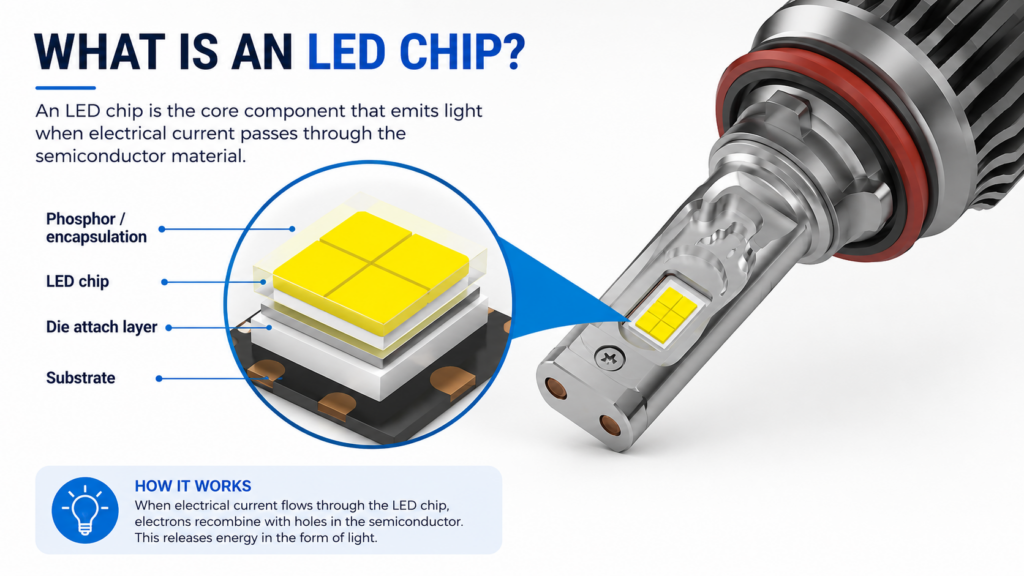
So, the “LED bead” or “LED package” that customers see is not the same as the LED chip itself. The chip is only the core light emitting part inside the package.
The Substrate Comes First, Then the Chip
Many buyers only ask what chip is used, but often ignore what is underneath the chip.
The substrate is the base that supports the chip and helps conduct heat away from it. For automotive lighting, especially high power LED headlights, the substrate is very important.
Common substrate materials include:
| Substrate Type | Features | Common Applications |
|---|---|---|
| Aluminum substrate | Lower cost, acceptable thermal performance | Medium and low power LED products |
| Copper substrate | Better thermal conductivity | High power headlights and auxiliary lamps |
| Ceramic substrate | Good insulation, high temperature resistance, strong thermal stability | High end LED packages and automotive lighting modules |
| COB substrate | Multiple chips directly mounted on one board | Work lights, auxiliary lamps, wide area lighting products |
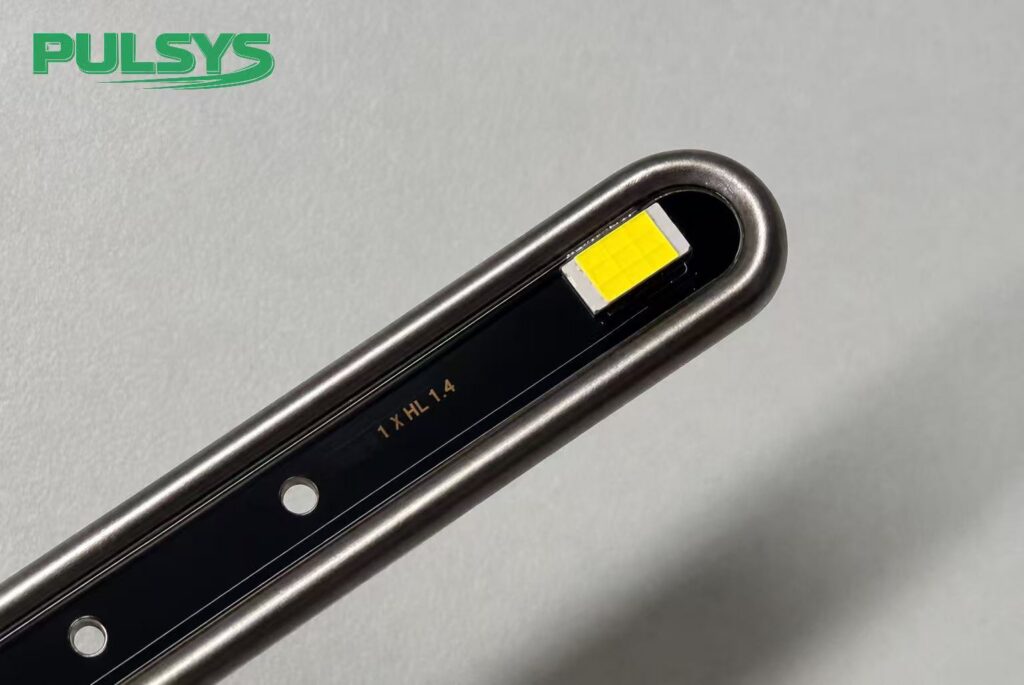
For LED headlights, heat generated by the chip needs to move through the chip, substrate, thermal material, lamp body, fan or heatsink, and finally into the air.
If any part of this thermal path is weak, the chip temperature will rise. As a result, brightness drops, lifespan becomes shorter, and product failure risk increases.
This is why two LED headlights both labeled as 60W can perform very differently. One may run stably, while the other may become dim after only a few minutes.
More LED Chips Does Not Always Mean Better Performance
In the LED headlight market, some products use “more chips” as a selling point. But more chips do not always mean higher brightness, and they do not always create a better beam pattern.
For automotive headlights, the light source must be close to the original halogen filament position and shape. This is because the original reflector or projector is designed around the halogen filament.
If the LED light emitting area is too large or too scattered, the light may not focus correctly. This can cause poor beam control, glare, weak cutoff, and uneven road illumination.
A good LED headlight chip design should meet several requirements:
- Concentrated light emitting area
The closer the light source is to the original halogen filament position, the easier it is to create a correct beam pattern. - Proper chip size and layout
Larger chips can support higher power, but if the layout is not accurate, the beam pattern may become worse. - High chip integrity
The emitting surface, edges, and phosphor coating should be consistent. This affects brightness, color temperature, and stability. - Thermal design must match the power
A chip may be able to handle higher power, but the whole lamp must also have enough thermal capacity to support stable operation.
In simple terms:
LED chips are not better just because there are more of them. A better chip solution depends on larger size, better integrity, accurate positioning, and proper heat dissipation.
Common LED Chip Sizes: 35mil, 40mil, 45mil, 51mil, and 55mil
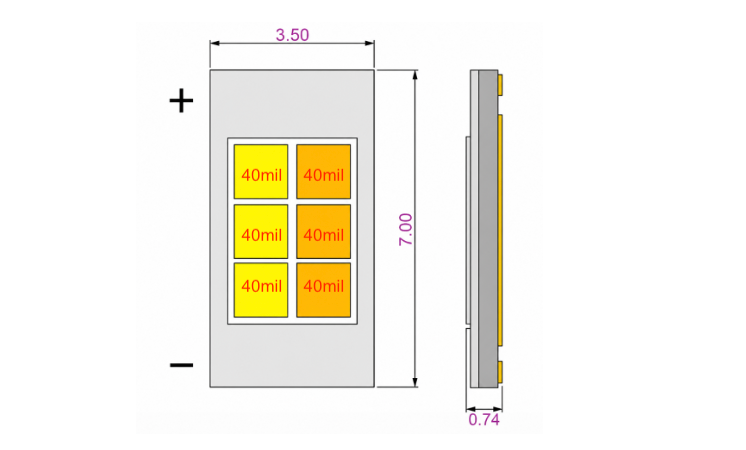
In the LED headlight industry, we often hear chip sizes such as 35mil, 40mil, 45mil, 51mil, and 55mil.
Here, mil is a unit of size. 1 mil equals 0.001 inch, or about 0.0254 mm. For example, a 45mil chip usually means the chip side length is about 45mil, which is around 1.14 mm.
The following table gives a general reference:
| Chip Size | Approximate Size in mm | Common Positioning | Common Power Range per Chip |
|---|---|---|---|
| 35mil | About 0.89 mm | Entry level or low to medium power products | Around 1W to 2W |
| 40mil | About 1.02 mm | Medium power products | Around 2W to 3W |
| 45mil | About 1.14 mm | Mainstream LED headlight products | Around 3W to 5W |
| 51mil | About 1.30 mm | Medium to high power products | Around 5W to 7W |
| 55mil | About 1.40 mm | High power products | Around 6W to 10W |
Please note that these values are general industry references, not absolute standards.
The actual power depends on chip brand, package structure, substrate material, driving current, thermal design, and the complete lamp structure.
For example, the same 45mil chip may perform very differently in two products. If the substrate has poor thermal conductivity, the driver is unstable, or the fan is weak, the lamp may drop power quickly even if the initial brightness looks high.
On the other hand, with a better substrate, stable driver, and efficient thermal structure, the lamp can maintain brightness more reliably.
Common LED Chip Brands
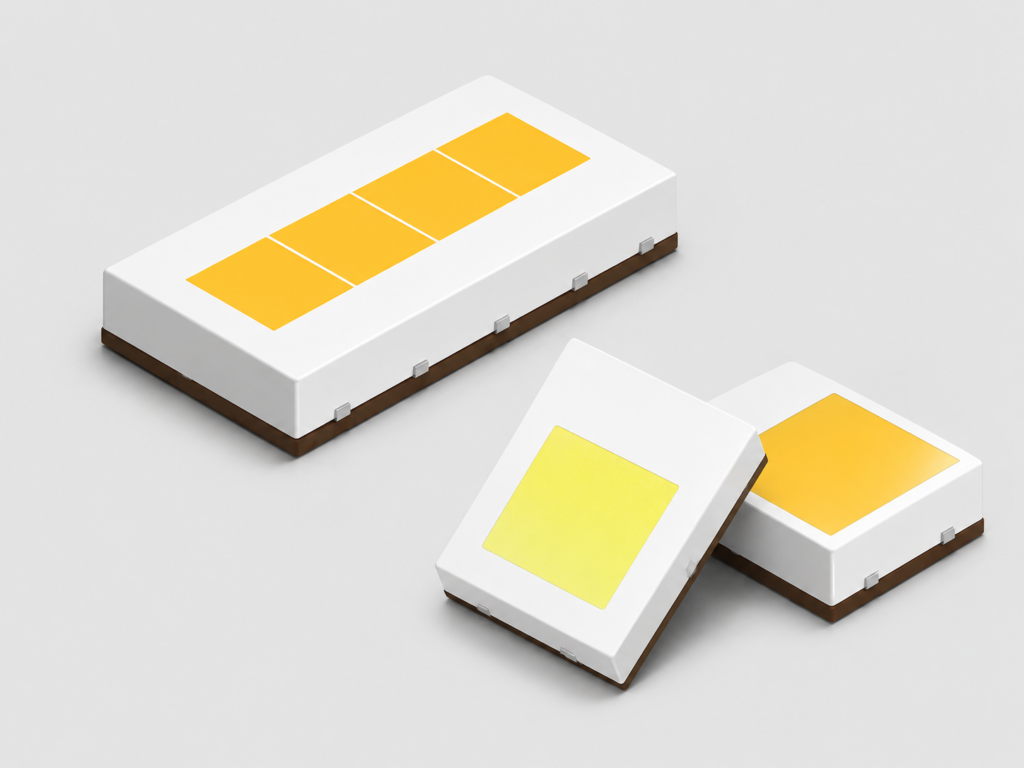
Common international LED chip or LED light source brands in the automotive lighting industry include:
| Brand | General Features |
|---|---|
| OSRAM / ams OSRAM | Well known in automotive lighting, LED, and sensor applications |
| Lumileds / Philips related LED sources | Widely used in automotive LEDs, LUXEON series, and high power LED applications |
| Nichia | A leading brand in white LED technology and high precision light sources |
| Seoul Semiconductor | Used in automotive lighting, display, and general lighting applications |
| Cree LED | Known for high power LED applications |
| San’an | One of the major LED chip manufacturers in China |
| Epistar | Common in the LED chip and packaging supply chain |
| Bridgelux | Often used in lighting grade LED applications |
| LatticePower | Seen in China’s LED chip and packaging supply chain |
When purchasing LED headlights in bulk, buyers should not rely only on the supplier’s claim that the product uses a certain brand of chip.
It is more important to confirm:
- Whether the chips are genuine
- Whether the supply is stable
- Whether brightness, color temperature, and voltage are consistent across batches
- Whether complete testing data is available
- Whether the chip can work stably under high temperature
- Whether the chip matches the lamp’s beam design, driver, and thermal structure
Many low cost products may claim to use “imported chips” or “premium brand chips.” But without test data and stable supply chain control, this claim may not mean much in real performance.
How Many Watts Does One LED Chip Usually Support?
Many buyers ask: “How many chips does this lamp use?” or “How many watts can one chip support?”
This question cannot be answered by chip size alone. It also depends on the package structure and heat dissipation.
In general, larger chips can support higher current and higher power. But higher power also means more heat.
A general reference is:
| Chip Size | Common Driving Power per Chip | Suitable Products |
|---|---|---|
| 35mil | 1W to 2W | Small lamps and low cost products |
| 40mil | 2W to 3W | Medium power headlights |
| 45mil | 3W to 5W | Mainstream LED headlights |
| 51mil | 5W to 7W | Medium to high power headlights |
| 55mil | 6W to 10W | High power headlights with stronger thermal design |
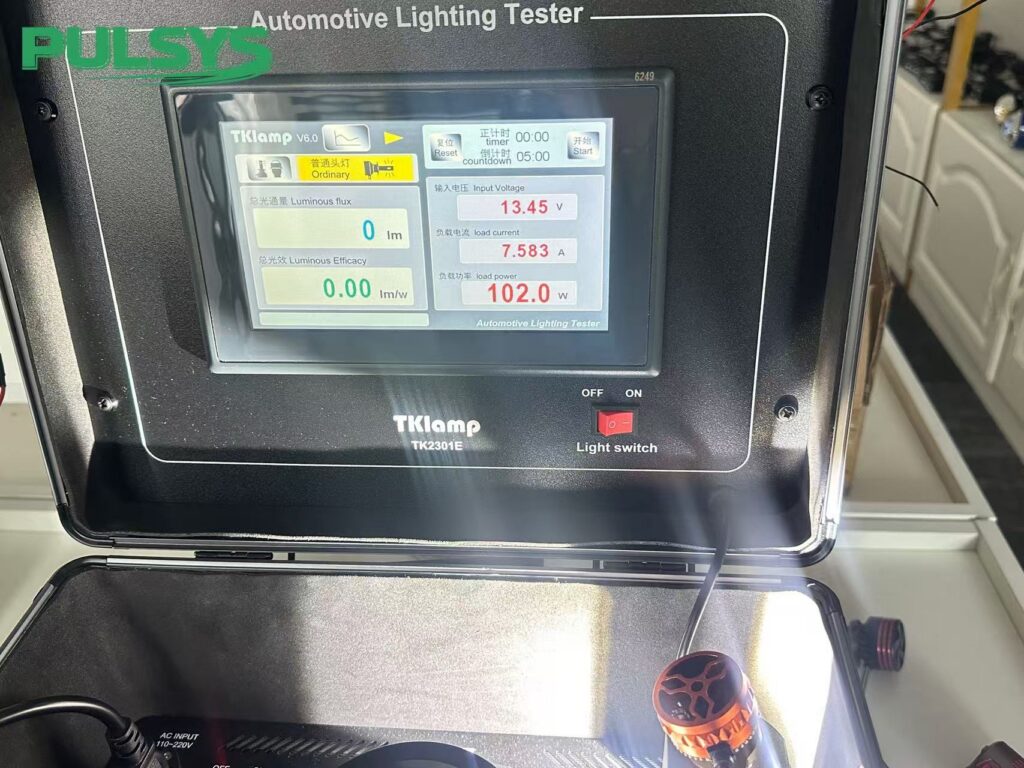
However, if an LED headlight is marked as 100W, it does not always mean it can run at 100W continuously.
Many products have different starting power and stable power.
| Parameter | Meaning |
|---|---|
| Starting Power | The power when the lamp is first turned on, usually higher |
| Stable Power | The real working power after the lamp has been running for a period of time |
| Rated Power | The power stated in marketing materials or specifications |
| Actual Power | The real power measured by testing equipment |
For wholesale buyers, stable power is more important than starting power.
Why Do Products with the Same Chip Perform Differently?
LED headlight performance is not decided by the chip alone. It is the result of the whole system.
1. Chip Position
The LED emitting point should be as close as possible to the original halogen filament position. If the position is too high, too low, too far forward, or too far backward, the beam pattern will be affected.
2. Light Emitting Area
If the emitting area is too large, the light may scatter. If the emitting area is too small but power is not enough, the brightness may be weak.
3. Substrate Thermal Conductivity
The larger the chip and the higher the power, the more important substrate thermal conductivity becomes. Copper, ceramic, and high quality aluminum substrates can make a big difference.
4. Driver Stability
A good driver controls current and allows the LED to work stably under different voltage and temperature conditions. A poor driver may cause flickering, overheating, power drop, or lamp failure.
5. Thermal System
The thermal system includes copper pipes, aluminum body, fan, cooling fins, thermal paste, and other components. A high power LED headlight cannot maintain long term brightness without proper heat dissipation.
6. Optical Matching
The final performance of an LED headlight should be judged by road illumination, not only by laboratory lumens. A good product should have a clear cutoff, proper hotspot, enough beam width, and controlled glare.
What Should Buyers Check When Sourcing LED Headlights?
If you are a wholesaler, distributor, or retrofit shop, here are the key points to check when selecting LED headlight products.
1. Do Not Only Look at Lumens
Many products claim 20,000LM or 30,000LM, but the actual tested output may be much lower. Stable brightness and real road performance are more important.
2. Do Not Only Look at Chip Quantity
More chips do not always mean better performance. For headlights, chip position, chip size, package type, and beam control matter more.
3. Pay Attention to Stable Power
Do not only ask “how many watts.” Ask the supplier:
What is the starting power?
What is the stable power?
How much power can it maintain after running for 10 minutes?
4. Check the Thermal Structure
High power LEDs must have proper heat dissipation. Key thermal parts include:
| Thermal Part | Function |
|---|---|
| Copper substrate | Quickly transfers heat away from the chip |
| Copper pipe | Improves heat conduction |
| Aluminum alloy body | Increases heat dissipation area |
| High speed fan | Provides active cooling |
| Cooling fins | Increase air contact area |
5. Check Beam Pattern Testing
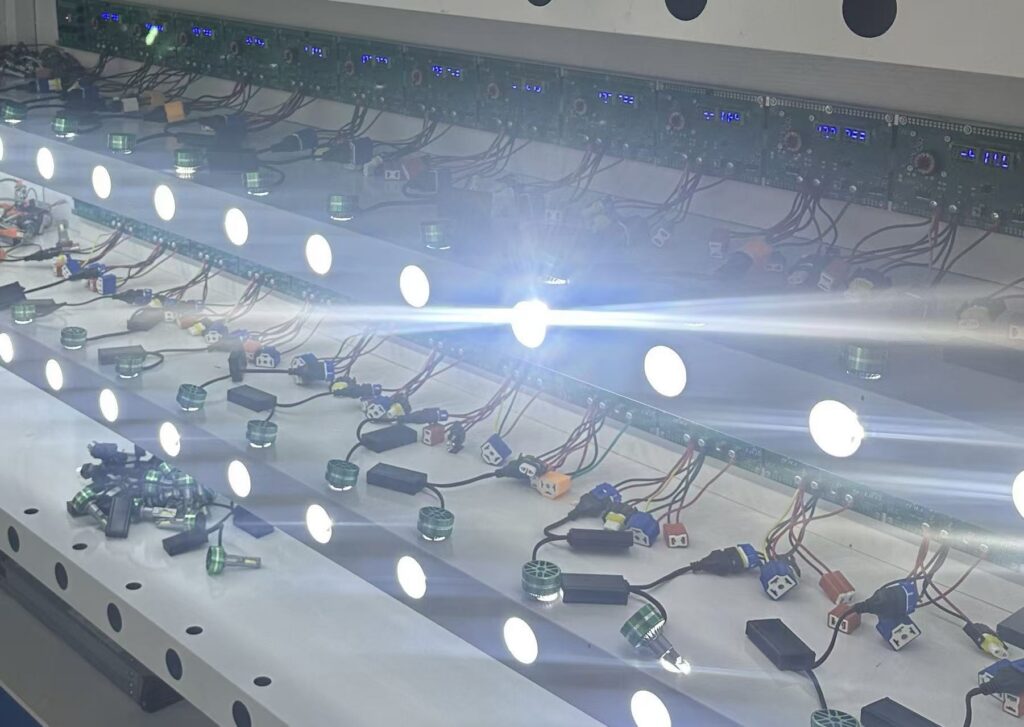
A professional LED headlight supplier should be able to provide beam pattern images, darkroom testing, road test photos, or photometric data.
Product photos and basic parameters are not enough to judge real performance.
6. Check Batch Consistency
For wholesale buyers, the biggest problem is not whether the first sample looks good. The real challenge is whether the second batch and third batch remain consistent.
Buyers should check whether the supplier has stable chip sourcing, stable driver solutions, and batch testing procedures.
7. Consider After Sales Risk
A very low price may look attractive at first. But if the failure rate is high, it can lead to returns, bad reviews, customer complaints, and long term damage to your brand.
For long term business, stability is more important than short term low cost.
Conclusion: A Good Chip Is Only the Foundation. System Matching Is the Key.
The LED chip is the core of an LED headlight, but it is not the only factor that determines performance.
A good LED headlight requires proper matching between the chip, substrate, driver, thermal structure, and optical design.
A larger chip can theoretically support higher power. But if the thermal system and driver cannot support it, the lamp may suffer from brightness drop, overheating, or shorter lifespan.
For wholesale buyers, the most important questions are:
Is the chip size suitable?
Is the emitting point close to the original halogen filament?
What is the stable power?
Is the thermal structure strong enough?
Is the beam pattern clear?
Is batch quality consistent?
A truly professional LED headlight is not simply about “more chips” or “higher lumens.” It is about finding the right balance between brightness, beam pattern, heat dissipation, lifespan, and cost.
Final Thoughts
At Pulsys, we focus on more than just LED chip selection. We help customers evaluate the complete lighting system, including chip size, substrate design, thermal structure, driver stability, and beam pattern performance.
If you are sourcing LED headlight bulbs for wholesale, distribution, or private label projects, our engineering team can help you compare different solutions and find the right balance between cost, brightness, stability, and market positioning.