
Introduction
Most buyers evaluate LED headlights by brightness, wattage, and price. Those numbers are visible on a spec sheet. What isn’t visible and what actually determines long-term performance is the cooling system behind the chip.
Poor heat dissipation leads to measurable consequences: accelerating lumen depreciation, shortened service life, fan failure, output instability, and in some cases, complete thermal shutdown. Understanding how a headlight manages heat tells you far more about its real-world value than peak lumen claims ever will.
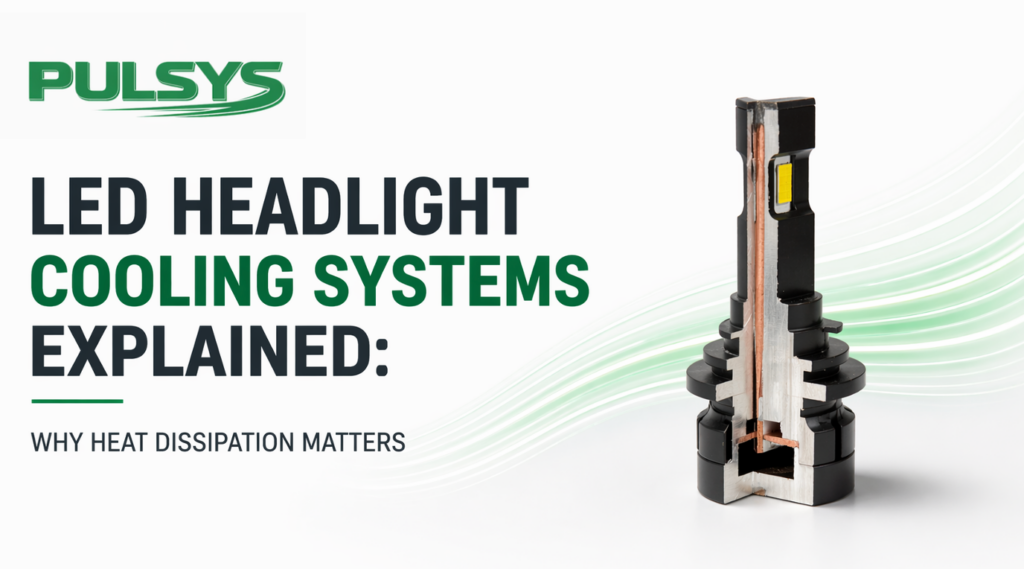
Why Do LED Headlights Generate Heat?
LEDs are more energy-efficient than halogen or HID sources, but they are not 100% efficient. A significant portion of electrical input, typically 60–70%, is converted to heat rather than light.
The higher the power output, the greater the thermal load that must be managed. Heat concentrates at three specific points: the LED chip itself (junction), the substrate or copper board beneath it, and the driver circuit. If that heat is not moved away quickly, junction temperature rises and elevated junction temperature is the primary cause of LED performance degradation.
This is not a minor technical concern. Every 10°C increase in junction temperature can reduce LED lifespan by 30–50%, depending on the chip and operating conditions. Heat management is not supplementary to LED design , which it is central to it.
What Is a Headlight Cooling System?
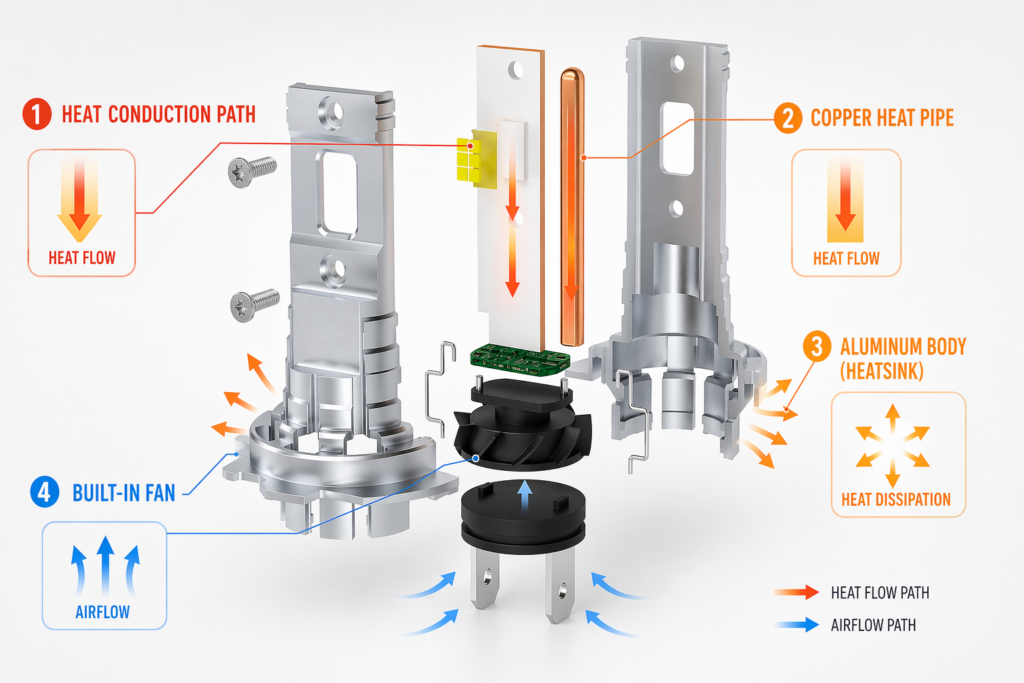
A headlight cooling system is not a single component. It is the complete thermal pathway that moves heat from the LED chip to the surrounding environment fast enough to maintain stable operating temperatures.
LED Chip: The heat source. All thermal management starts here. The goal of every downstream component is to pull heat away from this point as quickly as possible.
Each part of the system has a specific role:
Copper Substrate: The first stage of heat transfer. Positioned directly beneath the LED chip, copper’s high thermal conductivity (≈400 W/m·K) pulls heat away from the junction rapidly, preventing localized heat buildup at the chip base before it reaches the rest of the system.
Heat Pipes: The transport layer. Sealed tubes using phase-change fluid move heat from the substrate to the heat sink body far faster than solid metal conduction alone. Used in designs where the chip and heat sink cannot be placed in direct contact, or where heat needs to be distributed across a larger surface area quickly.
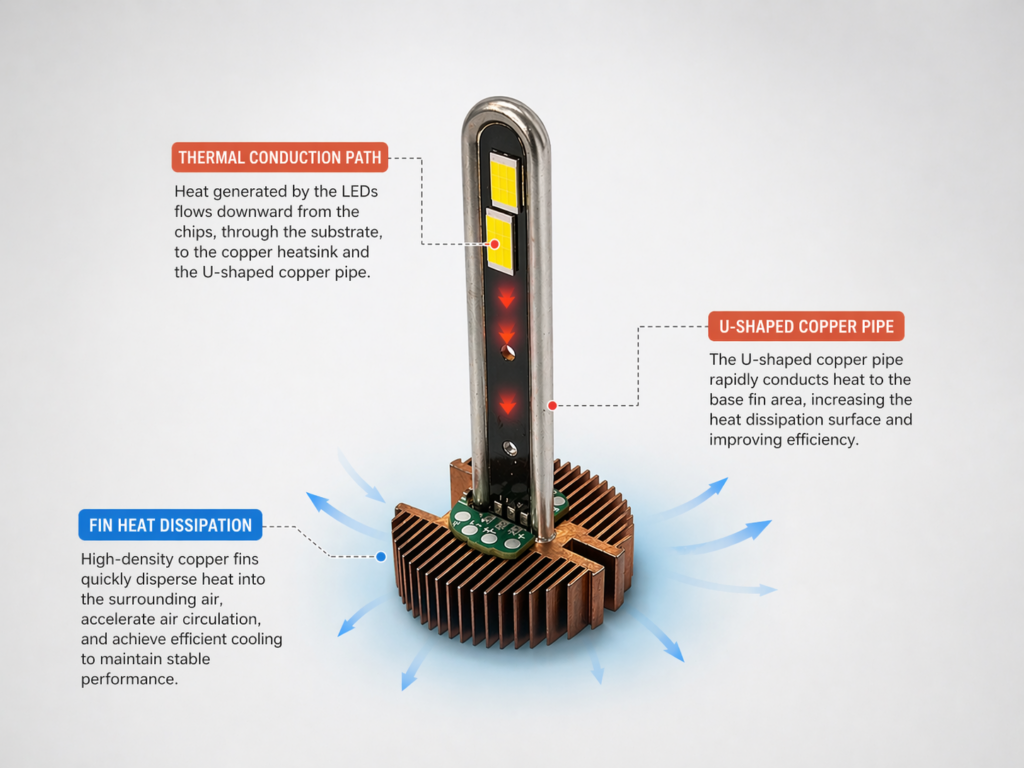
Fin Heat Sink: The primary dissipation surface. Aluminum fins multiply the surface area exposed to air, allowing heat to transfer from the solid structure into the surrounding environment through convection. The larger and more numerous the fins, the greater the passive dissipation capacity, but only if heat can reach them efficiently from the chip.
Aluminum Housing: The structural heat sink. In many LED headlight designs, the housing itself is cast or extruded from aluminum alloy and serves as part of the thermal path. Heat conducted from the substrate travels into the housing body, which then dissipates into the surrounding air through its outer surface. When the housing is in direct contact with the vehicle’s headlight assembly, it can also conduct heat into that structure, further expanding the effective dissipation area. The housing is passive by nature. Its contribution depends on material grade, wall thickness, and how much surface area is exposed to airflow.
Cooling Fan: The active accelerator. A fan forces airflow across the fin structure, replacing warm air at the fin surface with cooler ambient air continuously. This prevents the boundary layer of air around the fins from saturating with heat, which would otherwise slow down convective dissipation. Without airflow, even a large fin array reaches thermal equilibrium at a temperature that may still be too high for stable LED operation.
Thermal Interface Materials (TIM): The gap fillers. Microscopic surface irregularities between components create air pockets that act as thermal insulators. Thermal paste or thermal pads fill these gaps, ensuring heat transfers across each junction in the path rather than being blocked by trapped air.
Thermal Path Design: The structural logic that connects everything. The sequence, contact quality, and material choices across the entire chain determine whether the system functions as designed. A high-quality fan attached to a heat sink with poor chip-to-substrate contact will still produce elevated junction temperatures.
The most critical measure is not how large any individual component is, but how efficiently the entire path functions under continuous load.
Common Types of LED Headlight Cooling Systems
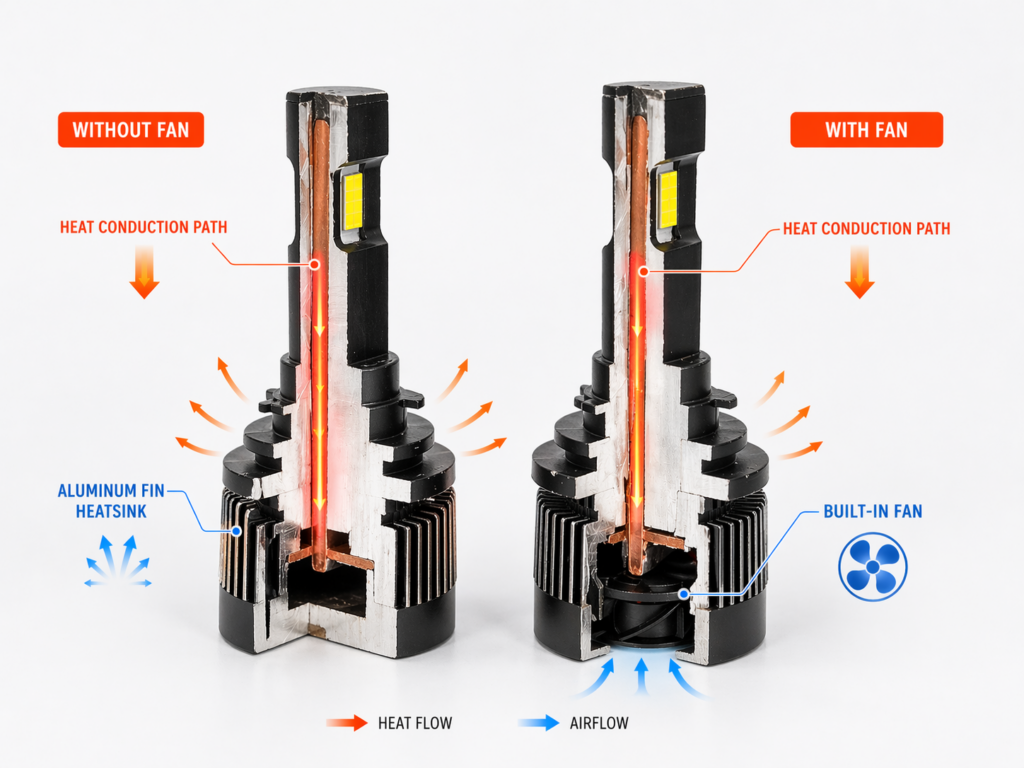
Fan-Cooled Systems
Active cooling uses a built-in fan to force airflow across the heat sink. This approach handles high thermal loads effectively and is common in high-power LED headlight designs.
The trade-off is mechanical complexity. Fans have moving parts. Long-term reliability depends entirely on motor quality, bearing grade, and whether the fan is rated for continuous duty cycles. A poor-quality fan running at elevated temperatures will fail, and when it does, the headlight will follow.
Fanless Heat Sink Systems
Passive systems rely on conductive and convective heat transfer through aluminum fins or a large heat sink body, with no moving parts.
These designs are quieter, simpler, and eliminate fan failure as a failure mode. The limitation is thermal capacity. At higher wattages, passive-only designs can saturate, meaning the heat sink can no longer absorb heat faster than it accumulates, leading to thermal throttling or sustained high junction temperatures.
Fanless systems are appropriate when the power level is matched to the passive thermal capacity of the design. When they are not matched, the absence of a fan becomes a liability.
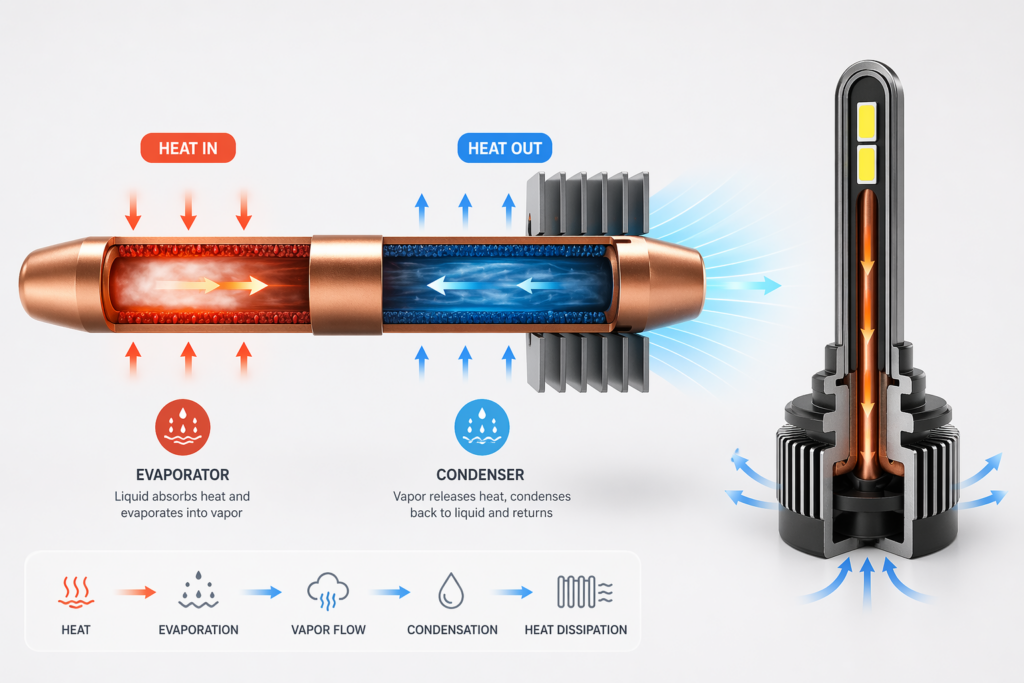
Heat Pipe or Copper-Assisted Cooling
Heat pipes use sealed, fluid-filled tubes that transfer heat through evaporation and condensation. They can move heat 10–100× more effectively than solid copper or aluminum over the same distance.
Copper-substrate designs improve the thermal interface between the LED chip and the heat sink body, reducing thermal resistance at the critical junction point. Both approaches are used in designs that prioritize sustained output stability over cost reduction.
Braided or Flexible Heat Sink Designs
Flexible heat sink structures are used in some aftermarket products to improve fitment across different vehicle housings. The concept is to increase surface area while accommodating installation constraints.
Actual performance depends on material conductivity, contact quality, and the overall thermal path, not the physical size of the structure. A large flexible heat sink with poor thermal contact at the chip performs worse than a compact, well-engineered passive design.
Why Is Heat Dissipation So Important in LED Headlights?
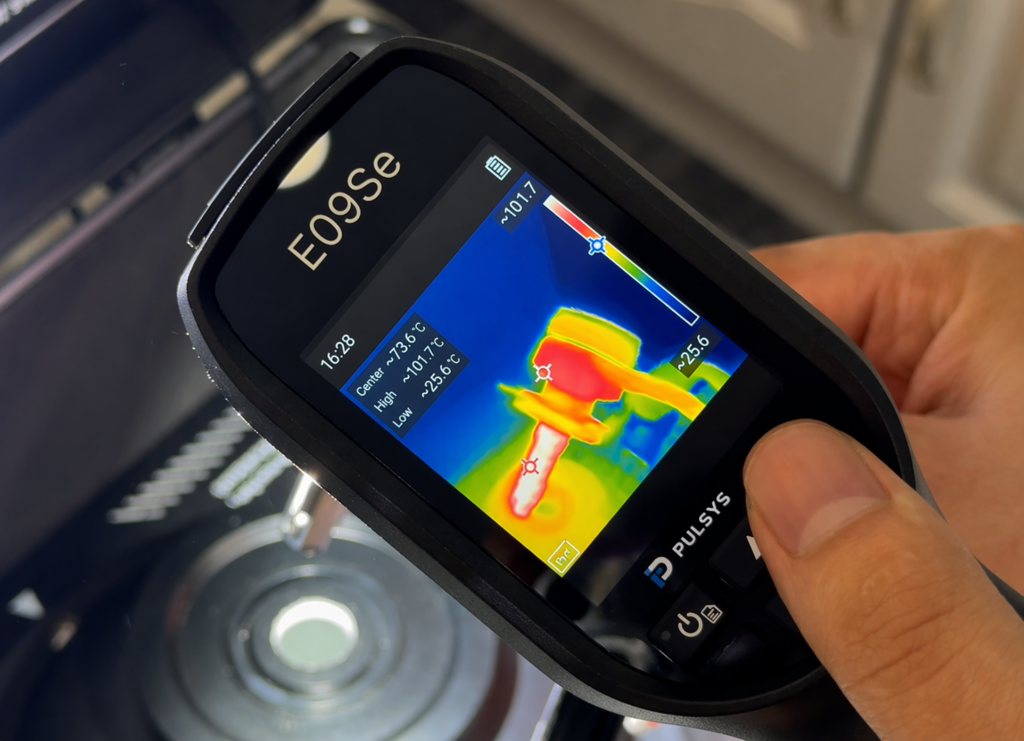
1. It Directly Controls Brightness Stability
LEDs lose output as junction temperature rises. A light rated at 6,000 lumens at startup may produce significantly fewer lumens after 30 minutes of operation if the cooling system cannot maintain stable temperatures. The brightness you see in a 10-second demonstration may not reflect the brightness you drive with.
2. It Determines Actual Lifespan
Manufacturers cite lifespan ratings measured under controlled thermal conditions. In a poorly cooled headlight, the actual operating temperature regularly exceeds those conditions, and the rated lifespan becomes irrelevant. Every hour of elevated-temperature operation accelerates lumen depreciation and component aging.
3. It Affects Reliability Across All Components
Heat affects more than the LED chip. Elevated temperatures degrade driver circuitry, solder joints, capacitors, and fan motors. A headlight that runs hot will show failures across multiple components over time — not just at the light source.
4. It Determines Whether Two Similar-Spec Products Perform the Same
Two headlights with identical rated wattage and lumen output can perform very differently in practice if their thermal management differs. Nominal specifications reflect test conditions. Real-world thermal performance separates products that last from products that don’t.
5. It Affects Safety
Overheating can trigger thermal protection circuits that reduce output mid-drive. In extreme cases, it can cause component failure. Brightness inconsistency, unexpected dimming, and instability are not just inconveniences, they are safety concerns for night driving.
What Happens When a Headlight Has Poor Cooling?
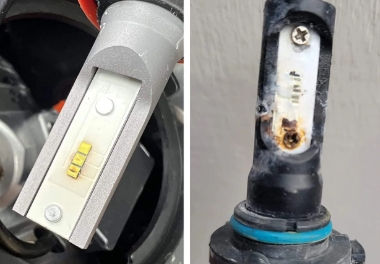
Users with under-cooled LED headlights typically observe:
- Brightness drop during extended use — output visibly decreases after 20–30 minutes
- Faster lumen depreciation — the light dims permanently over weeks or months of use
- Fan noise or early fan failure — a symptom of poor fan quality or sustained thermal stress
- Unstable output — flickering or inconsistency caused by driver or chip thermal stress
- Shorter product lifespan — components degrade faster than rated
- Thermal shutdown events — the protection circuit cuts output to prevent damage
These are not random failures. They are predictable outcomes of insufficient heat dissipation.
How to Judge Whether a Cooling Design Is Good
Wattage, lumen ratings, fan size, and housing appearance are poor proxies for cooling quality. They are visible, but they do not describe thermal performance.
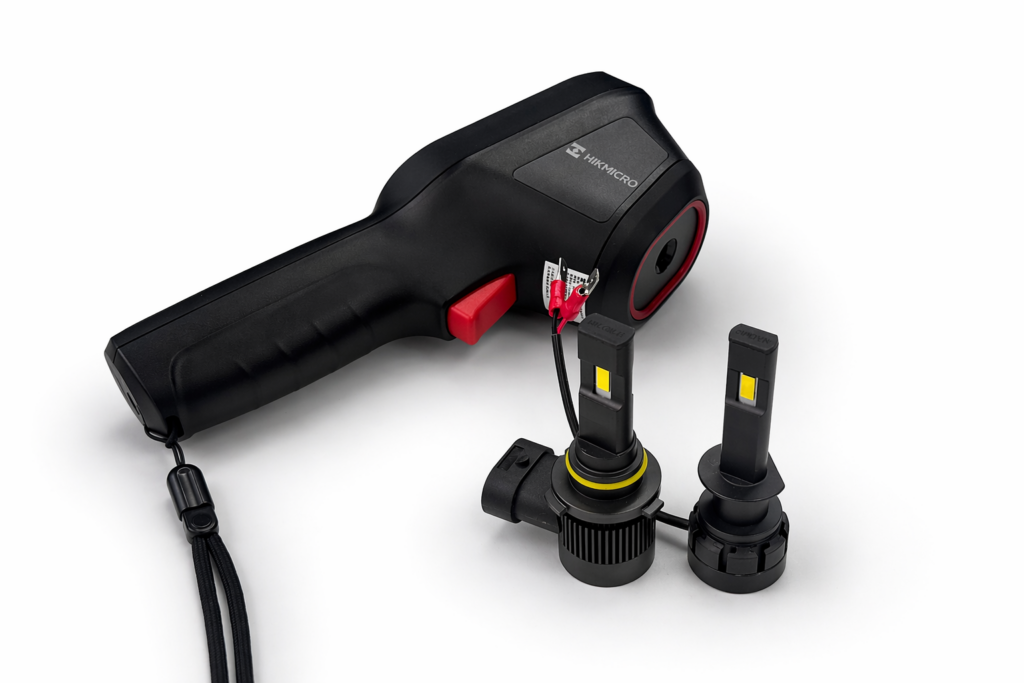
The questions that actually matter:
- What is the thermal path from chip to environment? Is there a continuous, low-resistance path, copper substrate to heat pipe to aluminum sink, or are there gaps and thermal bottlenecks?
- What are the fan specifications? Bearing type, rated duty cycle, and operating temperature range matter more than fan diameter.
- What is the power-to-thermal-capacity ratio? A 100W design with a heat sink sized for 60W will always run hot.
- How does the product perform under sustained use? Short burst tests do not reveal thermal saturation. Ask for data on sustained output.
- What materials are used at the thermal interface? Cheap thermal paste or poor substrate contact increases junction temperature even when the heat sink itself is adequate.
A good cooling system is not the one that looks the biggest, it is the one that keeps the light performing consistently over time.
Final Thoughts
Cooling is not an optional feature in LED headlight design. It is a core performance variable. A headlight with excellent brightness and poor thermal management will underperform a moderately bright headlight with a well-engineered cooling system, every time, over every meaningful timescale.
High lumen numbers attract attention. Stable lumen output over thousands of hours of use is what actually delivers value.
Any reliable LED headlight design is built around a thermal management approach that is appropriate for its power level, not bolted on as an afterthought.
If you are evaluating LED headlight solutions for your brand or market, thermal design should be one of the first criteria you review, not the last. It determines everything else downstream: consistency, warranty liability, end-user experience, and brand reputation.
Q1: Do all LED headlights need active cooling (a fan)?
Not necessarily. Whether a fan is required depends on the power level of the design. Lower-wattage LEDs can operate within safe temperature ranges using passive heat sinks alone. High-power designs, typically above 30–40W per bulb, generate more heat than passive systems can reliably dissipate under continuous use, making active cooling necessary. The issue is not whether a fan is present, but whether the chosen cooling method matches the thermal load of the specific design.
Q2: Is a bigger heat sink always better?
Size alone is not a reliable indicator of performance. What matters is the complete thermal path, from the LED chip through the substrate, into the heat sink body, and out to the ambient air. A large heat sink with poor thermal contact at the chip, or made from low-conductivity material, will underperform a compact, well-designed system with an efficient thermal path. Surface area helps, but only if heat can reach that surface efficiently.
Q3: How do I know if my LED headlight is overheating?
The most common signs are brightness that visibly drops after 20–30 minutes of continuous use, output that fluctuates or flickers without an obvious electrical cause, fan noise that increases over time or stops entirely, and a housing that becomes extremely hot to the touch shortly after startup. Lumen depreciation that happens faster than expected over weeks or months is also a sign of sustained thermal stress.
Q: What is junction temperature, and why does it matter?
Junction temperature refers to the operating temperature at the LED chip’s p-n junction, the point where light is actually generated. It is the most critical thermal measurement in LED performance. Manufacturers specify a maximum junction temperature (typically 125–150°C for automotive LEDs) above which degradation accelerates rapidly. The cooling system’s job is to keep junction temperature well below that ceiling during normal operation. Most users never see this number on a product listing, but it is one of the most important variables in long-term performance.
Q4: Can a poor cooling system damage my vehicle?
Direct vehicle damage from LED headlight overheating is uncommon, but not impossible. The more typical risks are: heat transfer into the headlight housing, which can warp plastic reflectors or damage seals over time; interference with nearby wiring or connectors in tight engine bays; and in rare cases, thermal runaway in very low-quality driver circuits. Beyond hardware risk, a headlight that dims significantly during use reduces visibility, which is the more immediate safety concern.
Q5: Is fan noise a sign of a cooling problem?
Not always. Some fan-cooled designs produce audible noise during operation, which is a characteristic of the fan type rather than a malfunction. However, fan noise that increases noticeably over time, becomes irregular, or is accompanied by output instability typically indicates bearing wear or thermal stress on the motor. A fan that fails silently, stopping without obvious symptoms, is more dangerous than one that signals wear through noise, because the headlight will continue operating at unsafe junction temperatures without warning.
Q6: What should I ask a supplier about their cooling design?
Ask for the thermal path description, what materials carry heat from the chip to the environment, and in what sequence. Ask for the rated maximum operating temperature and how it was tested. Ask whether the design has been validated under continuous use rather than just peak conditions. Ask about fan bearing type and rated lifespan if the design is fan-cooled. Suppliers who can answer these questions specifically and consistently are more likely to have engineered the thermal system deliberately rather than assembled it for appearance.