
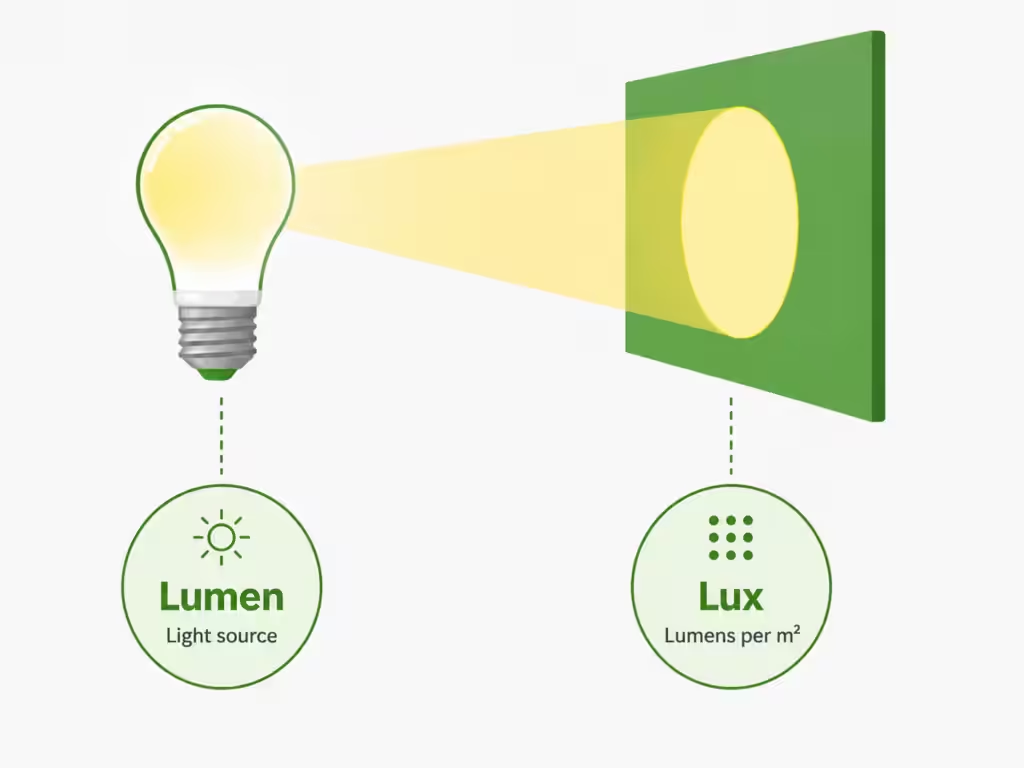
When buyers compare LED headlights, fog lights, off-road lights, or work lights, they often focus only on lumens. This guide explains the difference between lux, lumens, luminous flux, and light intensity. It is written for automotive lighting distributors, retrofit shops, fleet buyers, and product teams who need to compare lighting products more accurately.
The key point is simple: lumens measure total light output; lux measures usable light on a surface.
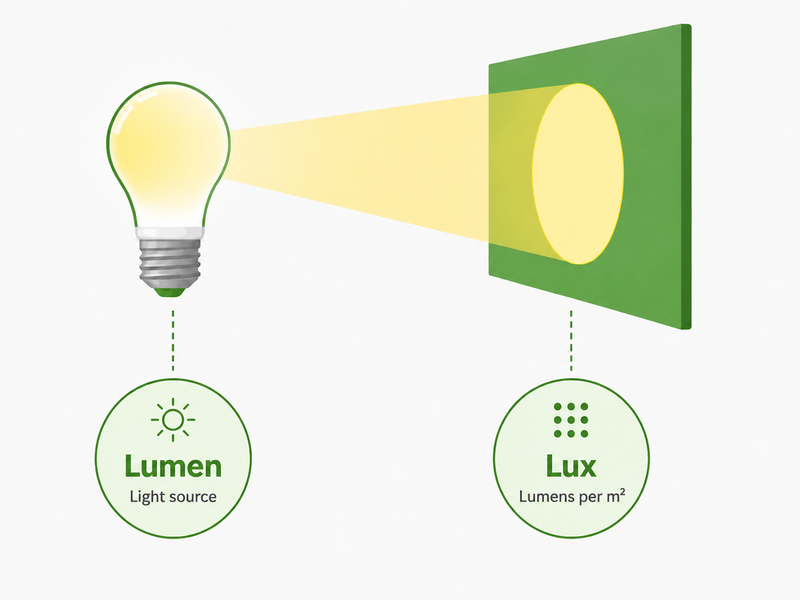
Lux and Lumens
Lux is the amount of light received by one square meter of surface; one lux equals one lumen per square meter. The unit is lx.
Lumen is the total amount of visible light produced by a light source. The unit is lm.
The main difference is practical. Lumens describe the lamp itself. Lux describes the result after the light reaches a target area.
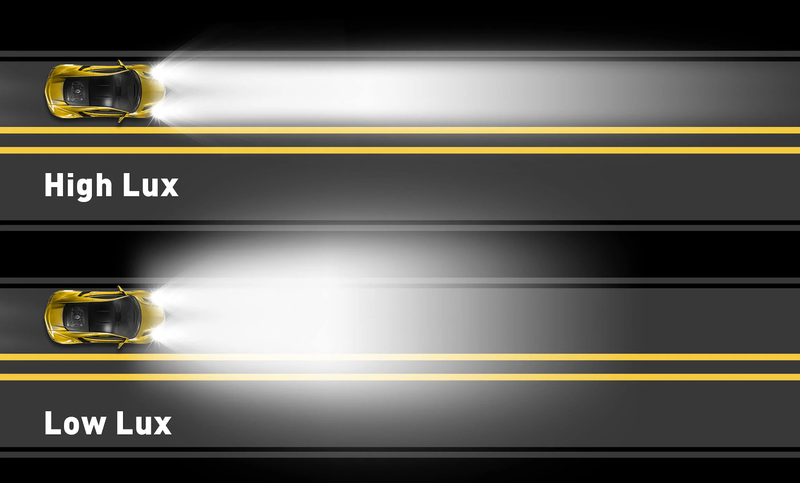
For example, two LED headlights may both claim 8,000 lumens. One may have a focused beam, clear cutoff, and strong center lux at distance. The other may scatter light everywhere, causing glare but weak road illumination. On paper, both look bright. On the road, only one performs well.
This is why serious lighting comparison should include both lumens and lux, not just advertised lumen numbers.
Luminous Flux
Luminous flux means the total luminous flux emitted, or the amount of light emitted by a source. It is measured in lumens.
Luminous flux is useful when comparing LED chips, bulb designs, complete lamps, or light engines. It also helps calculate efficiency.
Example:
3,300 lm ÷ 30W = 110 lm/W
This means the lamp has a luminous efficacy of 110 lumens per watt. For buyers, luminous efficacy is useful because it shows how efficiently the product converts electrical power into visible light. As a practical reference, a standard 60-watt incandescent light bulb produces about 800–900 lumens.
But luminous flux alone does not show beam pattern, cutoff, glare, road coverage, or distance performance. In automotive lighting, these details decide whether the lamp is truly useful.
Light Intensity: Candela vs Luminous Flux
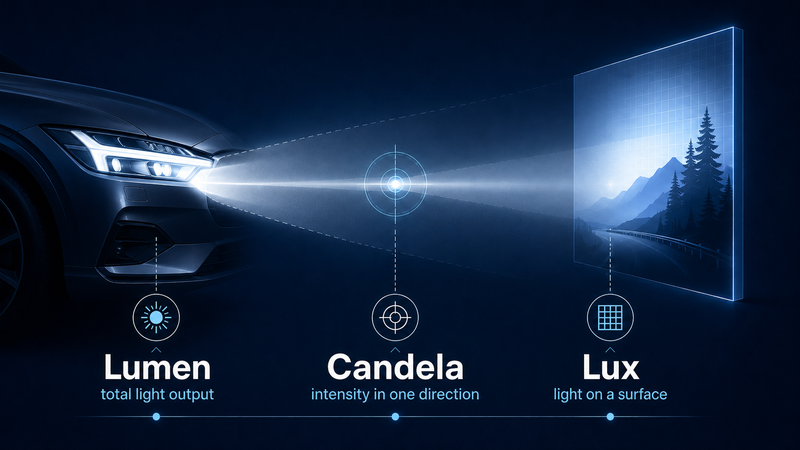
Candela, written as cd, measures luminous intensity in one specific direction; one candela is the standard unit for that directional light.
Lumens measure total light output. Candela measures how concentrated the light is in a direction, and it can be understood as lumens distributed over a solid angle.
A floodlight and a spotlight may have the same lumens. The spotlight will usually have higher candela because it sends more light forward in a narrow beam. At the same distance, higher candela usually means higher lux on the target. The floodlight spreads light over a wide area, so its intensity at distance is lower.
Simple diagram:
Lumens = total light from the lamp
Candela = light strength in one direction
Lux = light received on the road, wall, or floor
For headlights, candela and lux are very important. Drivers need controlled forward illumination, not scattered brightness.
Difference Between Lux and Lumen
A simple comparison:
The main difference is this: lumens tell you how much light comes out. Lux tells you how much light lands where you need it.
Example scenario:
Product A: 6,000 lumens, wide scattered beam Product B: 5,000 lumens, controlled projector beam
Product A may look brighter when viewed directly. But Product B may produce higher lux at 25 meters because the lens system puts the light on the road more efficiently.
For automotive lighting, this is common. A lamp with lower advertised lumens can perform better if the optical design is stronger.
Use lumens when comparing total output or efficiency. Use lux when testing road illumination, wall beam pattern, work surface brightness, or how well a specific area is illuminated.
Lumens Lux Calculation
The basic formula is:
Lux = Lumens ÷ Area, so one lux is one lumen per square meter
Example:
A lamp produces 1,000 lumens and spreads the light evenly over 10 square meters.
1,000 lm ÷ 10 m² = 100 lx
This formula is easy for room lighting, but automotive lighting is more complex. Headlights and fog lights do not spread light evenly. They have hotspots, cutoff lines, dark zones, and different beam angles.
Distance also matters. Under the inverse square law, doubling the distance from a light source reduces lux to one-quarter. As distance increases, the same light spreads over a larger area, so lux drops. This is why a headlight may look bright at 3 meters but weak at 25 meters.
When comparing lamps, always state the test distance.
Beam Angle and Light Distribution
Beam angle changes the result.
A narrow beam concentrates light. It gives higher lux at distance and is useful for long-range visibility. A wide beam spreads light. It gives better close-range coverage but lower intensity far away.
Common examples:
| Product Type | Beam Need | Main Focus |
|---|---|---|
| LED headlight | Controlled forward beam | Cutoff, distance, low glare |
| Fog light | Low and wide beam | Road edge, short-range visibility |
| Off-road spotlight | Narrow long beam | Distance and high candela |
| Work light | Wide flood beam | Area coverage and uniform lux |
This is also why “brighter” is not always better. If the beam is wrong, more power may only create more glare.
For road use, beam control is more important than raw lumen claims.
Using a Lux Meter
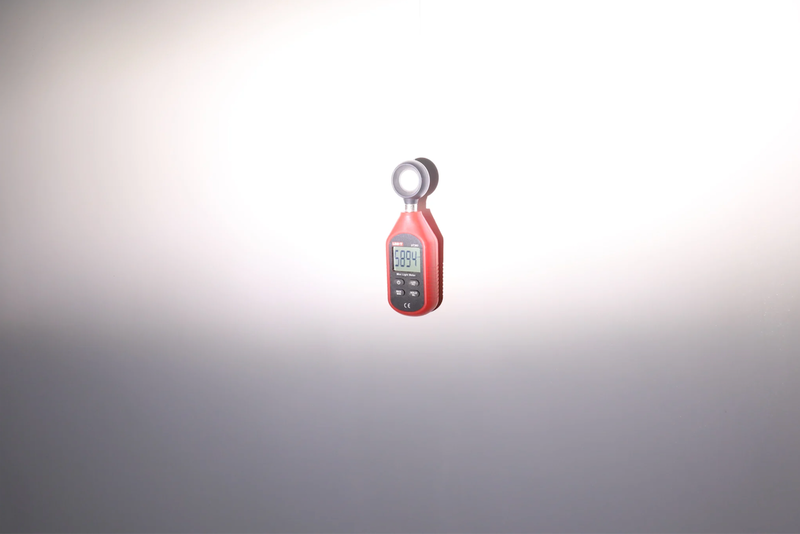
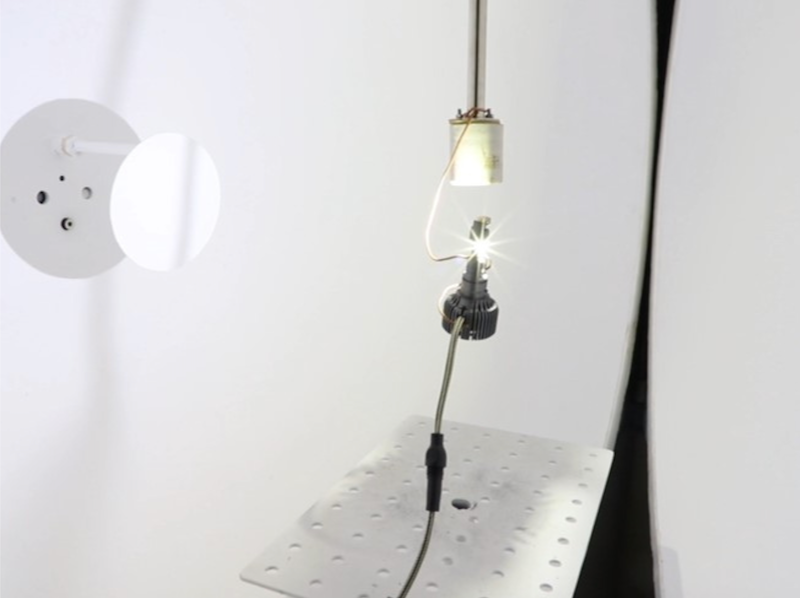
A lux meter measures light on a surface. It is useful for testing headlights, fog lights, work lights, garage lighting, and sample comparisons.
Basic testing steps:
- Fix the lamp in the same position every time.
- Use a fixed distance, such as 5m, 10m, or 25m.
- Turn off other lights.
- Keep the input voltage stable.
- Let the lamp run until the power becomes stable.
- Place the lux meter sensor flat toward the light.
- Take a center-point lux reading.
- Measure left, right, upper, and lower points.
- Record distance, voltage, wattage, and test environment.
For fair comparisons, measurements must be taken at the same distance. The meter helps determine how well a specific area is illuminated.
Do not test only the brightest point. A strong center hotspot does not mean the whole beam is good. For automotive lighting, side coverage, cutoff quality, glare control, and dark zones should also be checked.
A useful lux test should show the whole beam, not only the peak number.
Measuring Lumens
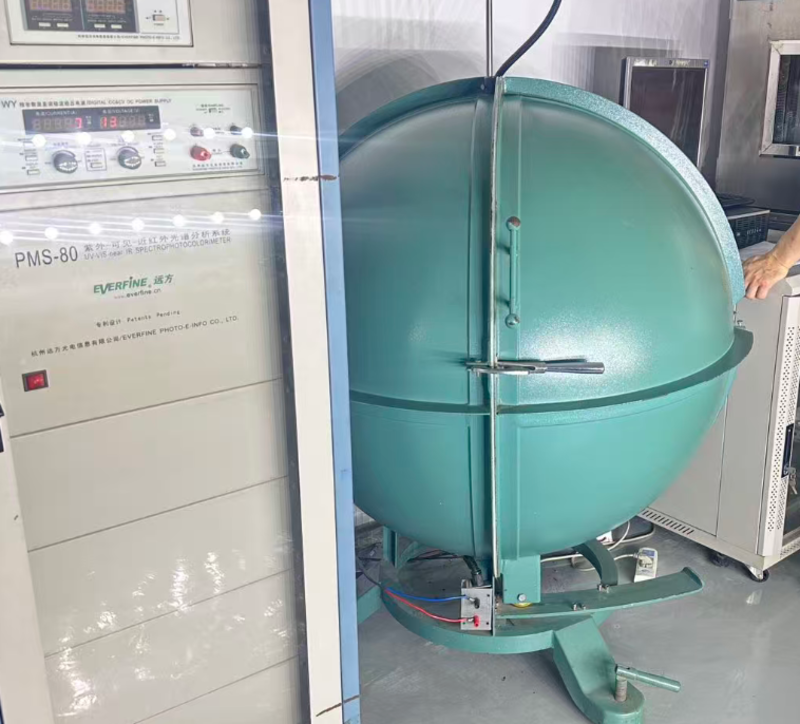
The proper tool for measuring total lumens is an integrating sphere, which measures the total luminous flux emitted by a lamp or luminaire. It collects light from all directions and gives a more accurate luminous flux result.
This is usually done in a lab. In a workshop or showroom, people often use lux readings to compare products, but those readings only show light on a measured surface rather than the total output from the source.
When sharing test data, clearly state how the measurement was done.
Recommended data to record:
- Test distance
- Input voltage
- Startup wattage
- Stable wattage
- Center lux
- Side lux readings
- Beam angle
- Test room condition
- Heat-up time before reading
For LED headlights, stable performance matters. Some products have high startup power but drop quickly after heating. That means the real road brightness may be lower than the first impression.
Common Measurement Errors
Many lighting tests are inaccurate because the setup is not controlled.
Common mistakes include:
- Lux meter placed at the wrong angle
- Test distance not fixed
- Reflections from white walls or shiny floors
- Different input voltage between samples
- Measuring before the lamp reaches stable temperature
- Comparing only center lux
- Ignoring beam pattern and glare
Reflections can make readings higher than reality. A clean dark test area gives more reliable data.
Repeat the test several times and use average values. For product development or buyer inspection, one reading is not enough.
When to Use Lux and When to Use Lumens
Use lux when you care about the light reaching a road, wall, floor, workbench, or an indoor lighting task in a specific space. In practice, offices are often lit to 400–500 lux, and a standard office desk is commonly around 500 lux. A kitchen countertop is often 500–600 lux. A corridor may need only about 100 lux.
Use lumens when comparing total light output from LED bulbs, chips, lamps, or fixtures.
For automotive lighting, use both.
A good evaluation should include:
- Lumens for total output
- Lux for usable illumination
- Candela for directional strength
- Beam pattern for optical control
- Watts for power consumption
- Lumens per watt for efficiency
- Heat performance for long-term stability
A high-lumen lamp with poor optics can cause glare and waste light. A well-designed projector or fog light may have lower lumens but better road performance.
Design and Specification Guidance
Choose the beam angle based on the application.
A headlight needs a clear cutoff and good forward throw. A fog light needs low, wide coverage. A work light needs even flood illumination. An off-road spotlight needs distance and high center intensity.
For product selection, do not ask only for lumens. Ask for:
- Stable wattage
- Beam pattern photo
- Lux test distance
- Center and side lux readings
- Color temperature
- Heat dissipation design
- Driver solution
- Waterproof rating
- Real vehicle installation feedback
For efficiency, check lumens per watt. But do not treat it as the only standard. A product with good lumens per watt but poor beam control may still fail in real use.
For road-legal products, also check applicable standards and local regulations. Different markets may have different requirements for headlights, fog lights, auxiliary lights, and off-road lights.
Units and Conversions
Main photometric units:
| Unit | Full Name | Meaning |
|---|---|---|
| lm | Lumen | Total visible light output |
| lx | Lux | Light received per square meter |
| cd | Candela | Light intensity in one direction |
Foot-candle is another illuminance unit used in some markets.
1 foot-candle ≈ 10.76 lux
1 lux ≈ 0.0929 foot-candles
Simple reminder:
More lumens = more total light
More lux = more light on the target surface
More candela = stronger light in one direction
Radiometric vs Photometric Notes
Photometric units describe visible light based on human eye response. Lux, lumens, and candela are photometric units.
Radiometric units measure physical radiant power. For example, irradiance is measured in watts per square meter.
Do not mix irradiance and illuminance. They are not the same.
Spectral weighting also matters. Human eyes respond differently to different wavelengths, and luminous measurements are based on human visual sensitivity, with monochromatic light near 555 nm used as the standard reference point. This is why white LED, amber LED, and blue-rich LED light can look different even when their electrical power is similar at a given wavelength.
Quick Reference: Lux vs Lumens
| Item | Lux | Lumens |
|---|---|---|
| Measures | Light on a surface | Total light output |
| Unit | lx | lm |
| Depends on distance | Yes | No, when measured at source |
| Depends on beam angle | Yes | Not directly |
| Best for | Road and surface testing | Source output comparison |
| Automotive use | Beam performance | Product output claim |
Conclusion
Lux and lumens are both important, but they answer different questions.
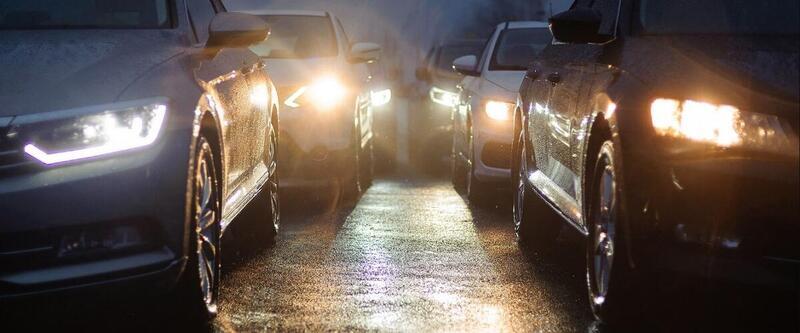
Lumens tell you how much visible light a lamp produces. Lux tells you how much useful light reaches the target surface. For automotive lighting, lux, beam pattern, candela, stable wattage, and heat control are more useful than lumen claims alone.
Before choosing LED headlights, fog lights, off-road lights, or work lights, measure the existing setup first. Compare beam shape, lux at distance, stable power, and real installation results.
A good automotive light is not just bright on paper. It must put stable, controlled, useful light exactly where the driver needs it.
For distributors, retrofit shops, and fleet buyers, the safest choice is to review both lab data and real vehicle testing before placing a bulk order. If you need help selecting a beam type, wattage, color temperature, or product structure for your market, ask for a custom lighting recommendation before production.