
Choosing between low beams and high beams may sound simple, but in real driving and in automotive lighting product selection, the difference goes far beyond brightness alone. Beam pattern, range, cutoff control, glare management, bulb compatibility, and weather performance all affect how a headlight system performs on the road. Industry standards such as those developed by SAE Internationalhighlight the importance of beam pattern control and proper light distribution in ensuring both visibility and glare reduction.
For drivers, using the correct beam improves visibility and reduces risk. For distributors, importers, workshop suppliers, and private label buyers, understanding these differences also helps with better product selection, clearer application guidance, and fewer installation or performance complaints.
In this guide, we explain the practical difference between low beams and high beams, when each should be used, how fog lights work with them, and what matters when choosing halogen, HID, or LED headlight bulbs.
If you are sourcing LED headlight products for your market, this topic is also directly tied to product positioning, beam quality, and customer satisfaction.
Why Should we Learn How to Use High Bean vs. Low Beam Headlights
Headlights are one of the most essential safety features on any vehicle, providing critical visibility for drivers and making the vehicle visible to other road users during nighttime driving or in low-light conditions. The two main types of headlights, high beam light and low beam headlights, are each designed for specific driving conditions to maximize both visibility and safety.
Understanding when to use high beams versus low beams is crucial for safe driving. Using the correct beam for the driving conditions not only improves your own visibility but also helps prevent blinding oncoming drivers, ensuring a safer environment for everyone on the road. According to guidance from the U.S. National Highway Traffic Safety Administration (NHTSA), drivers should dim high beams when approaching other vehicles to reduce glare and improve overall road safety.
What Is the Difference Between Low Beam and High Beam?
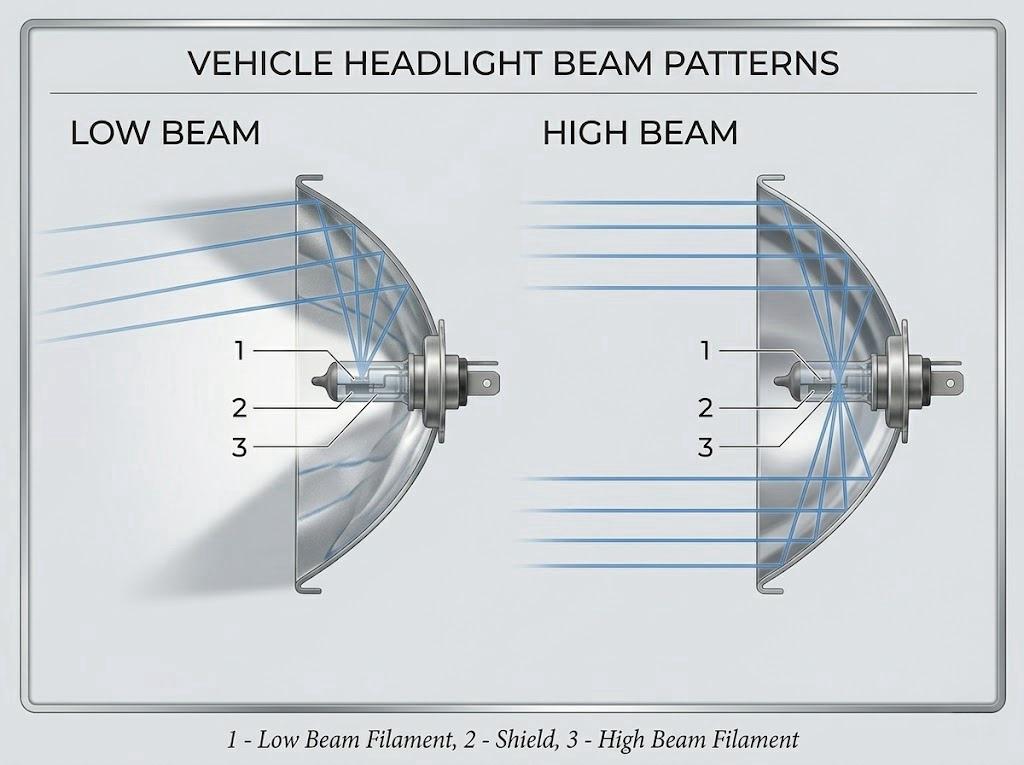
The difference between low and high beams is not just how bright they look. The main difference is how the light is distributed.
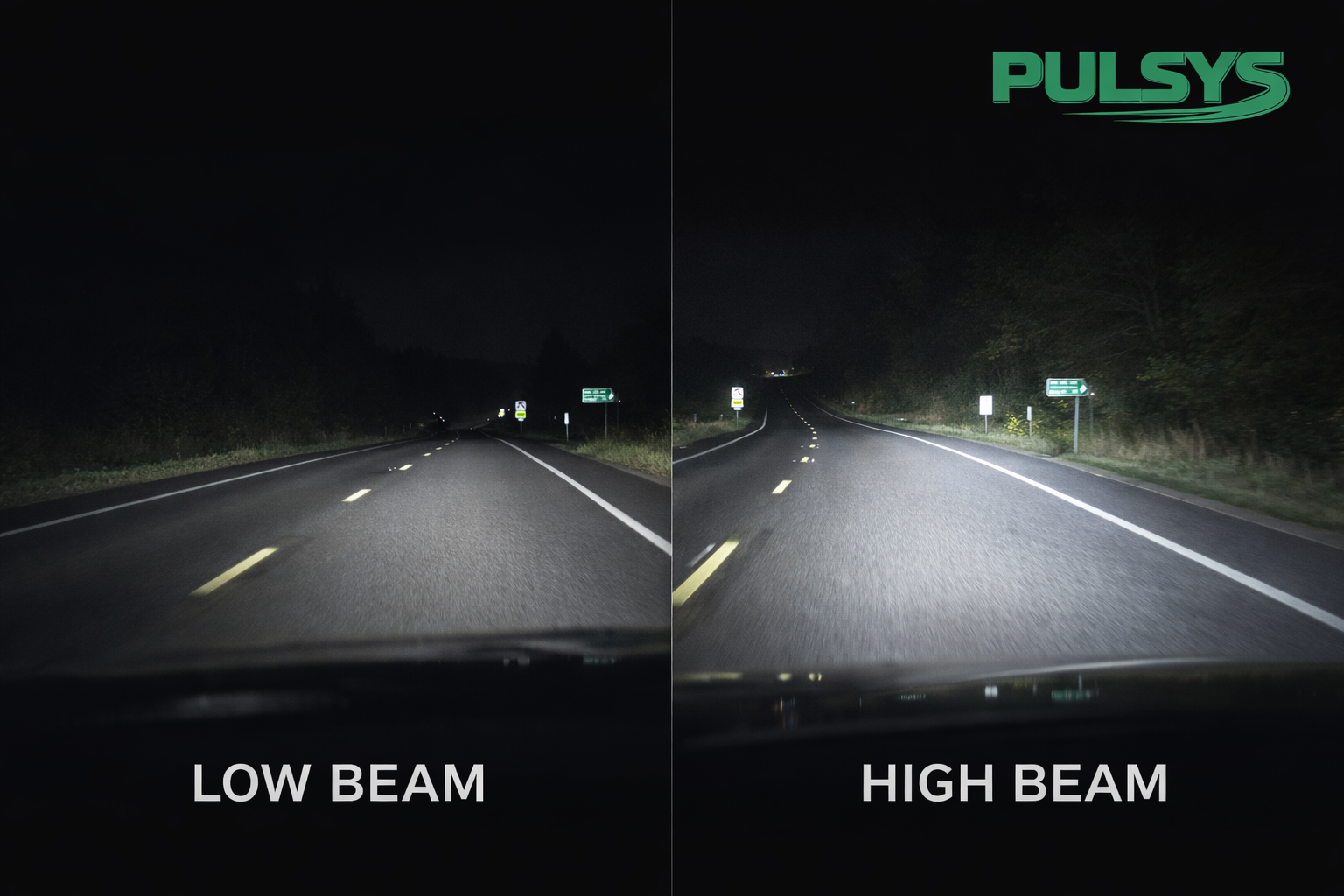
Low beams, also known as dipped beams, are designed for normal night driving and are the most commonly used headlights. They provide a controlled, road-focused beam pattern with a defined cutoff that helps reduce glare for other drivers and vehicles ahead. Low beams provide a softer, shorter light that’s perfect for urban areas driving, foggy conditions, or driving near other vehicles.
High beam sometimes called main beams or full beams light, which is designed to give you the brightest and most powerful light, allowing you to see further down the road. High beams usually create a longer and more concentrated beam pattern to improve long-distance visibility when no other traffic is nearby, which is suitable in rural areas, country roads.
Low Beam vs High Beam Quick Comparison
| Feature | Low Beam Headlights | High Beam Headlights |
|---|---|---|
| Primary purpose | Everyday nighttime driving | Long-range visibility on dark roads |
| Beam pattern | Wide, controlled, cutoff-based | Longer range, more concentrated |
| Range | Short to medium | Long |
| Glare risk | Lower when properly aimed | High if used near traffic |
| Best use | City roads, traffic, adverse weather | Rural roads, dark highways, no nearby vehicles |
| Weather performance | Better in rain, fog, and snow | Often worse in poor weather |
| Typical legal use | Standard driving beam | Restricted based on traffic and road conditions |
From a product perspective, the difference between low beam and high beam performance is created by optical design, bulb position, reflector or projector structure, and in some applications, the switching method used in a dual-beam system.
Quick Decision Guide: Which Beam Should You Use?
Practical Beam Selection Guide
| Driving condition | Recommended lighting |
|---|---|
| City streets or roads with traffic | Low beams |
| Dark rural road with no nearby vehicles | High beams |
| Fog, mist, heavy rain, or snow | Low beams, plus fog lights if equipped |
| Following another vehicle | Low beams |
| Oncoming traffic present | Low beams |
| Unsure about condition or legality | Low beams |
For both drivers and product buyers, the key idea is the same: the right lighting choice depends on road conditions, beam control, and proper application.
How Beam Pattern Affects Visibility, Glare, and Road Safety
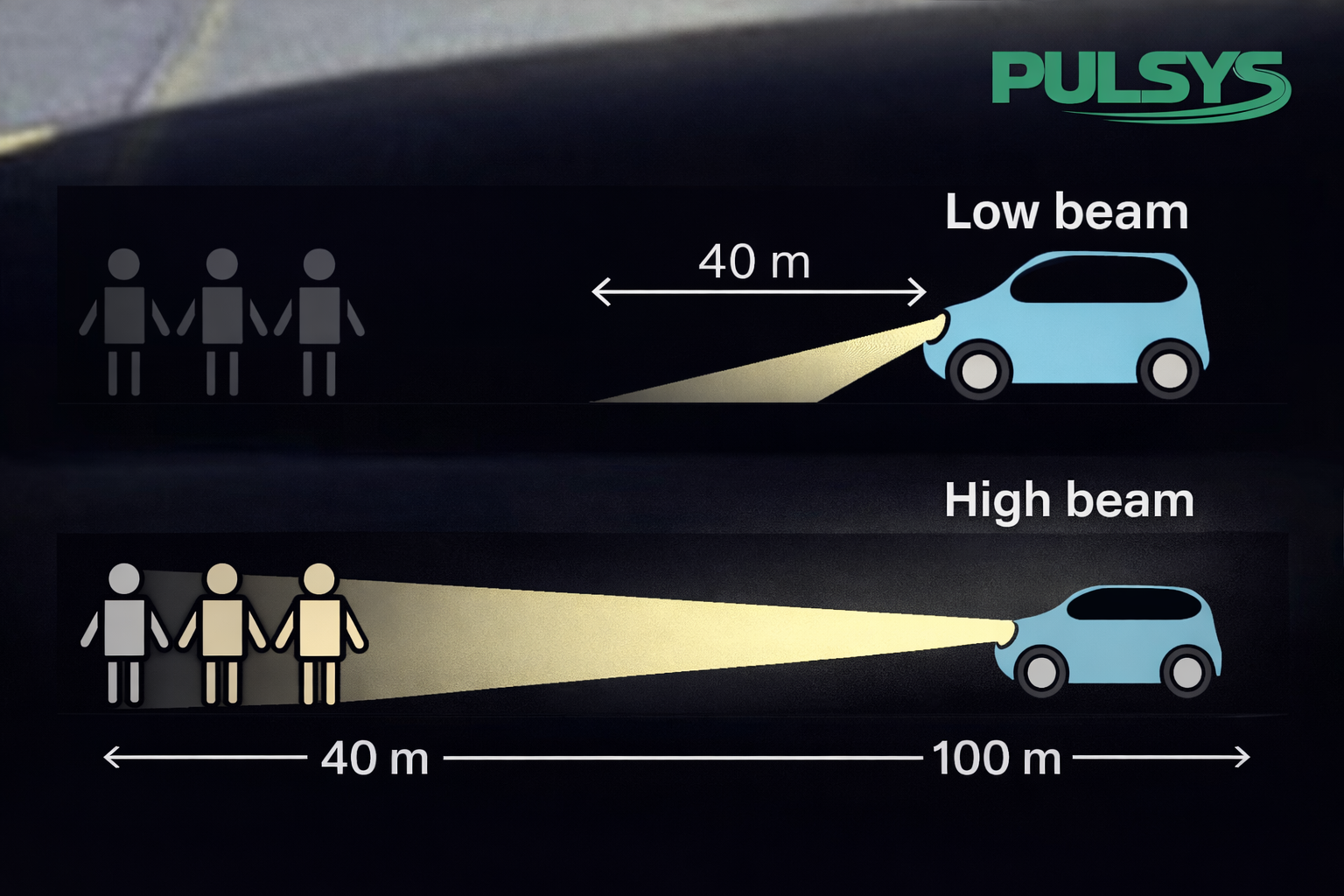
Low beam headlights help illuminate the lane, road edges, signs, pedestrians, and immediate hazards without sending excessive light into the eyes of other drivers. High beams extend detection distance, which can be useful on dark roads where hazards may appear far ahead. High beams provide additional light for improved visibility, but this extra illumination must be used responsibly.
However, stronger output does not automatically mean better visibility. If the beam pattern is poorly controlled, if the bulb geometry does not match the housing, or if the headlamp is misaligned, the result can be more glare, more scatter, and less usable seeing distance. High beams offer nearly double the sight distance of low beams but can be dangerous if used incorrectly.
This is especially important in the aftermarket. Many buyers still compare products mainly by lumen claims, but real world road performance depends much more on beam focus, cutoff quality, hotspot placement, and stability over time.
For B2B customers, this means a headlight bulb should not be evaluated by brightness claims alone. Optical match, thermal structure, fitment accuracy, and long-term consistency are often more important for building a successful product line.
Looking for LED headlight bulbs with better beam control and more stable real-world performance? Contact us to discuss product options for your market, application range, or private label program.
When To Use High Beams
High beams should be used when maximum forward visibility is needed and there are no nearby vehicles that could be affected by glare. High beams emit extra light, providing superior visibility of 350-500 feet on dark rural area, but can blind other drivers if not used properly.
Typical situations include unlit rural, mountain roads, open highways with low traffic, and other dark environments where the driver needs to detect hazards farther ahead. High beams should be used on dark rural roads when there are no streetlights and minimal ambient light.

High beams can help reveal:
- animals crossing the road
- sharp curves
- road debris
- obstacles beyond the normal reach of low beams
- lane changes or road shape in poorly lit areas
But high beams should be switched off when another vehicle is close enough to be affected.
When High Beams Help and When They Do Not
| Situation | Use High Beams? | Reason |
|---|---|---|
| Dark rural area with no traffic | Yes | Improves long-distance visibility |
| Empty highway at night | Yes | Helps detect hazards earlier |
| Rural areas without other vehicles | Yes | Improves the visibility in dark area |
| Oncoming vehicle present | No | Can blind or distract other drivers |
| Following another vehicle | No | Reflects into mirrors and causes glare |
| Heavy rain or snow | Usually no | Light scatters and reduces visibility |
| Fog or mist | No | Backscatter can make visibility worse |
In many places, common driving guidance is to dim high beam when an oncoming vehicle is within about 500 feet, and when following another vehicle within about 200 to 300 feet. Drivers should always follow local regulations.
For automotive lighting suppliers and distributors, high beam headlights performance should be presented responsibly. Longer range is valuable, but only when it is paired with correct beam control and proper application guidance.
When To Use Low Beams
Low beam lights, also called dipped beams, are the standard choice for most real-world driving conditions. They are intended for everyday use at night and in any situation where traffic, lighting conditions, or weather make high beams inappropriate. Dipped beams provide downward, asymmetric light to prevent glare and improve visibility within a limited distance, making them essential for road safety when other vehicles are present.
Low beams should be used for:
- city streets
- residential areas
- residential roads
- roads with street lighting
- well lit areas
- tunnels
- parking areas
- roads with oncoming traffic
- roads where another vehicle is ahead
- rain, heavy snow, fog, or mist

Low beams headlights are required by law to be used at night and in low-light conditions, and are the most commonly used headlights. They are angled towards the road and must always be on at night or in low-light settings such as tunnels.
Using low beams in various weather conditions, such as fog, rain, and heavy snow, is important to drive safely and maintain visibility. Drivers should switch to low beams in city streets, when following another vehicle, or approaching an oncoming car.
The reason low beams work better in traffic is simple. Their beam pattern is designed to illuminate the road while limiting upward glare.
Low beams are also usually the better choice in bad weather. In rain, fog, and snow, a more controlled beam helps reduce reflection back into the driver’s eyes.
For many drivers, low beam performance is actually the most important part of the headlight system because it is the mode used most often. That is why beam width, cutoff sharpness, hotspot placement, and glare control matter so much in headlight bulb design.
If your business serves workshop networks, retailers, or import channels, offering products with stable low beam performance can help reduce returns and improve customer trust.
Fog Lights vs Headlights: How They Work Together
Fog lights are often misunderstood. They are not a replacement for standard headlights, and they are not simply extra brightness.
Fog lights are mounted low on the vehicle, typically in or near the front bumper, and aim downward with a short, wide beam. Their purpose is to help illuminate the road surface, lane markings, and road edges in low-visibility conditions such as fog, mist, heavy rain, or snow. Fog lights are especially useful in foggy conditions, as they reduce glare and improve visibility compared to high beams.
They are typically used together with low beams, not instead of them.
Low Beam, High Beam, and Fog Light Comparison
| Item | Low beam | High beam | Fog light |
|---|---|---|---|
| Beam behavior | Wide, controlled beam with cutoff | Longer range, more concentrated beam | Low-mounted, short, wide beam |
| Best use | Normal night driving, traffic, poor weather | Dark roads with no nearby traffic | Fog, mist, heavy rain, snow |
| Main limitation | Shorter range | Higher glare risk | Not intended for primary forward lighting |
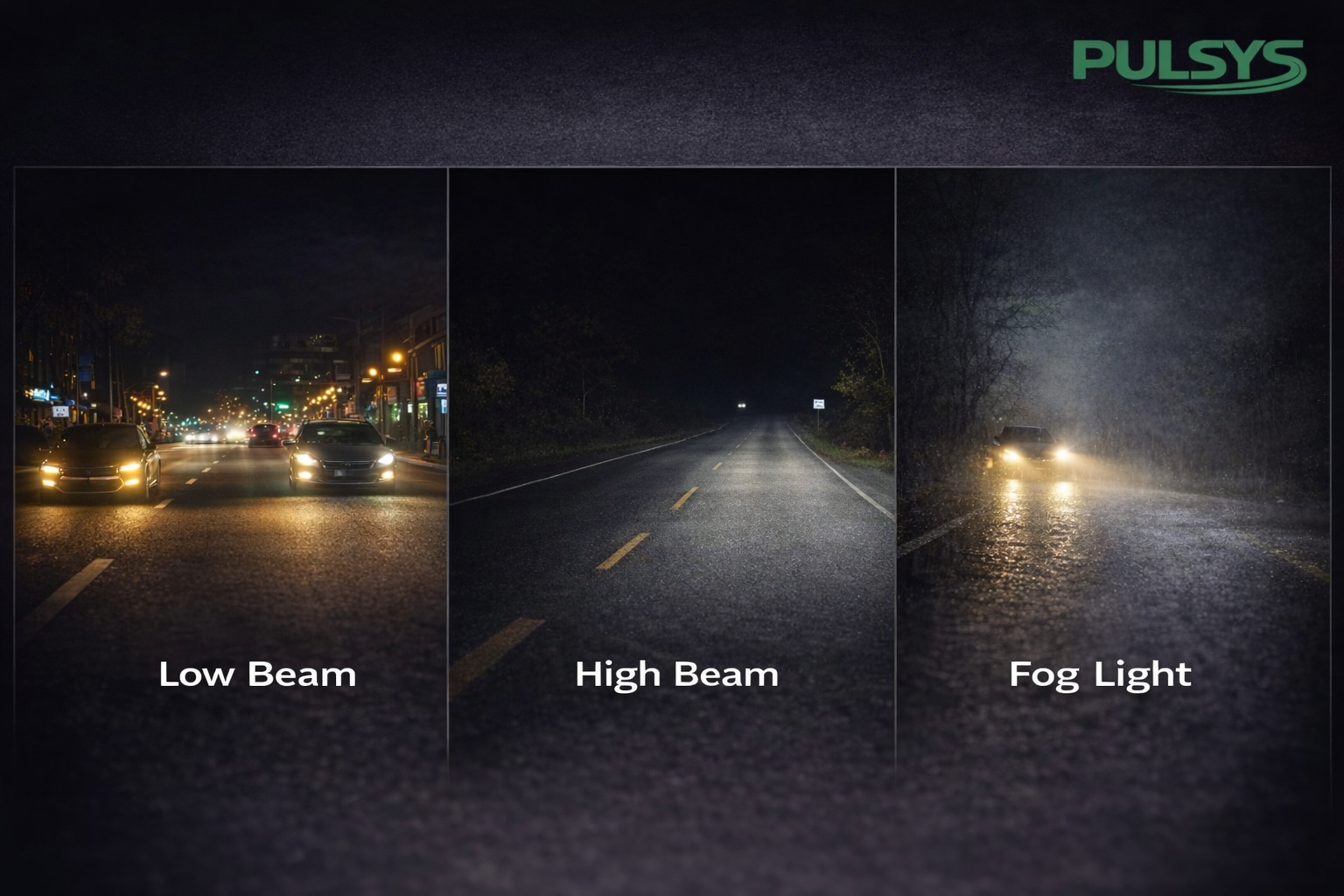
Using high beams in fog usually makes visibility worse because the light reflects off moisture in the air and comes back toward the driver. That is why low beams and fog lights are generally the better combination in those conditions.
For B2B buyers, fog lights and headlight bulbs should be positioned as different functional products, not as interchangeable upgrades. Clear product education helps customers choose the right solution and reduces misuse after installation.
If you are building a broader automotive lighting range, we can support product selection across headlight bulbs, fog light solutions, and market-specific applications.
High Beam Symbol, Low Beam Symbol, and Switching Methods
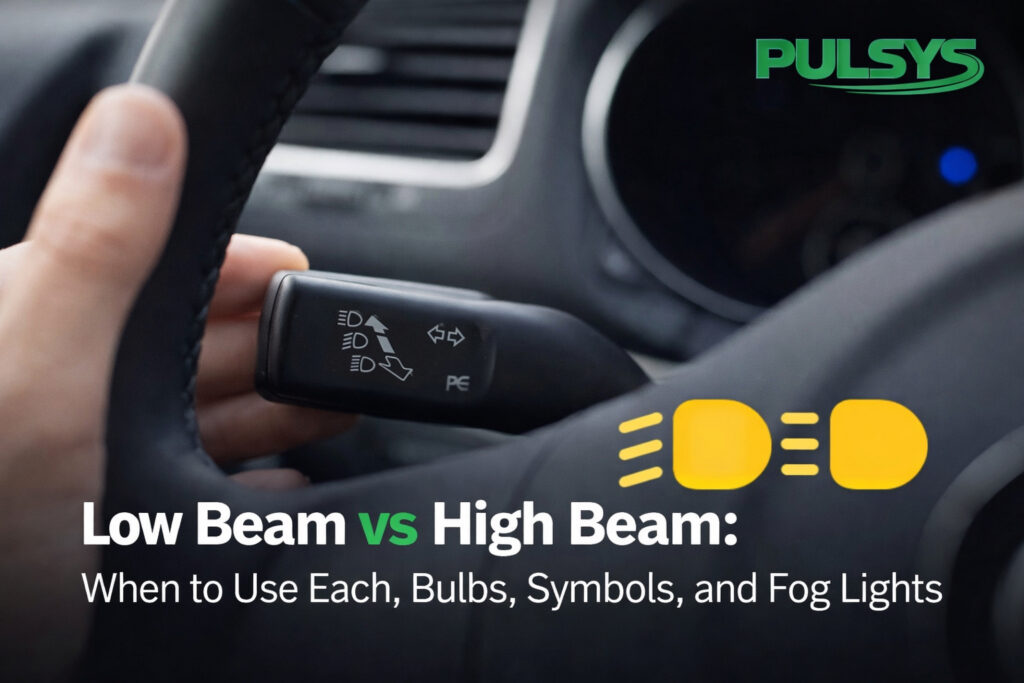
In many modern vehicles, the high beam control is located on the turn signal lever, which also controls the low beam headlights. Most vehicles switch between low beams and high beams using the turn-signal or light-control stalk. Some systems allow a momentary flash function, while others have a fixed high beam settings.
Modern vehicles may also include automatic high beams, a feature that uses sensors and cameras to detect driving conditions and oncoming traffic. These systems automatically switch between high and low beams to enhance safety and convenience.
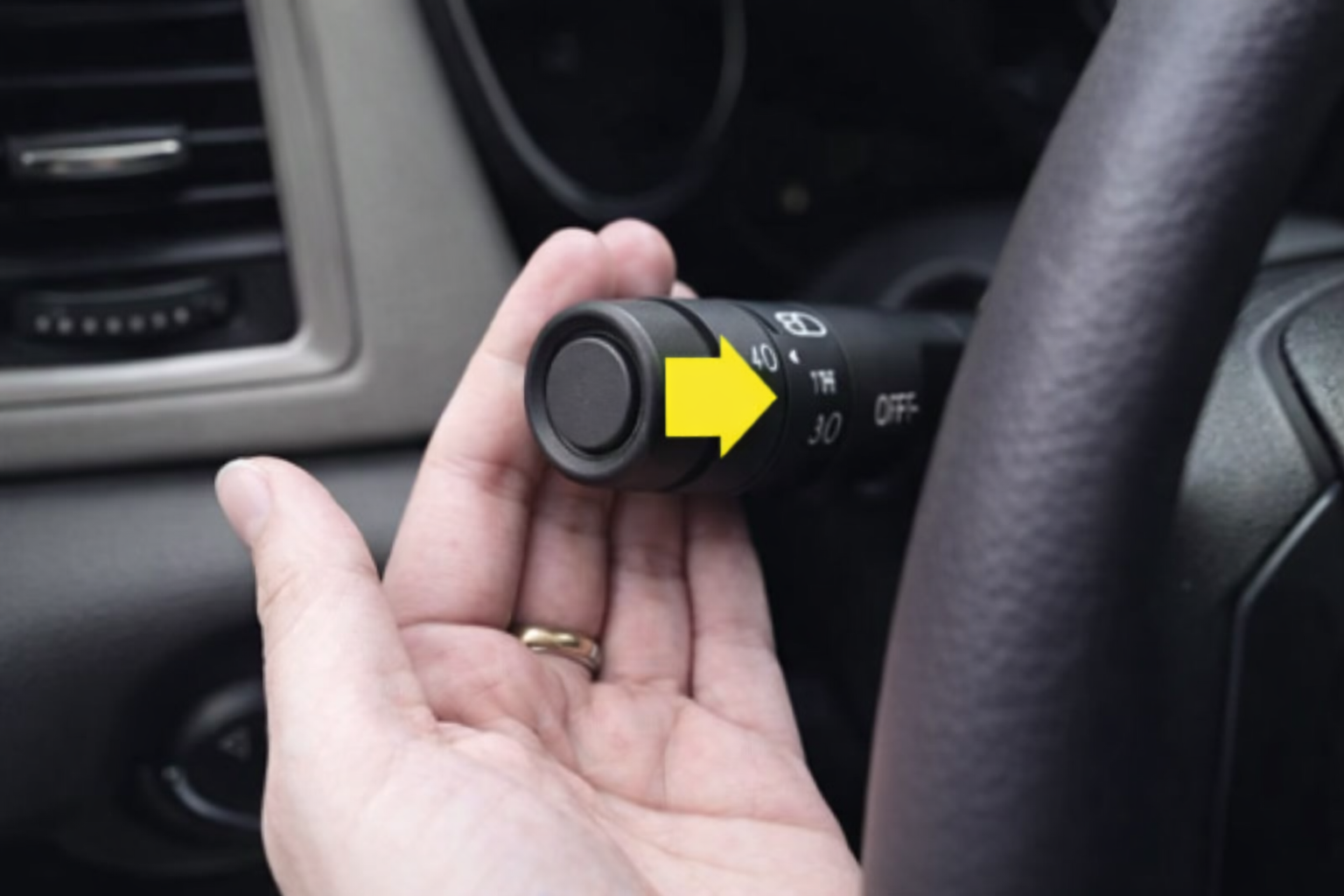
The dashboard symbols are usually easy to identify:
- High beam symbol: typically a blue headlamp icon with straight horizontal lines
- Low beam symbol: typically a green icon with downward angled lines
- Automatic high beam indicator: may appear in blue, green, or white depending on the vehicle
Some vehicles also include warning indicators for bulb failure, lighting system faults, or adaptive lighting problems.
For aftermarket product sales, it is useful to remember that more vehicles now include integrated electronics, fault monitoring, and system sensitivity. This makes compatibility and driver stability more important than before.
Dual-Beam vs Separate Bulbs: How High and Low Beams Are Implemented
Vehicles do not all use the same headlight structure.
Some use separate bulbs for high beams and low beams, each with its own bulb size. Others use a dual-beam bulb, where one bulb handles both functions—these often use the same bulb size for both high and low beams headlights in a single unit.
In most vehicles, bulbs for high and low beams are typically located in specific positions within the headlight assembly, depending on the vehicle design. This placement can affect how easily you can access or replace each bulb.
A dual-beam system usually relies on either multiple filaments, multiple light sources, or a mechanical or electrical switching structure depending on the technology.
Common examples include:
- H4 / 9003 / HB2 for dual-beam applications
- H11 often used for low beam
- 9005 / HB3 often used for high beam
- 9006, H7, and other bulb types depending on the vehicle platform
Upgrading to LED headlight bulbs can significantly improve your nighttime driving experience.
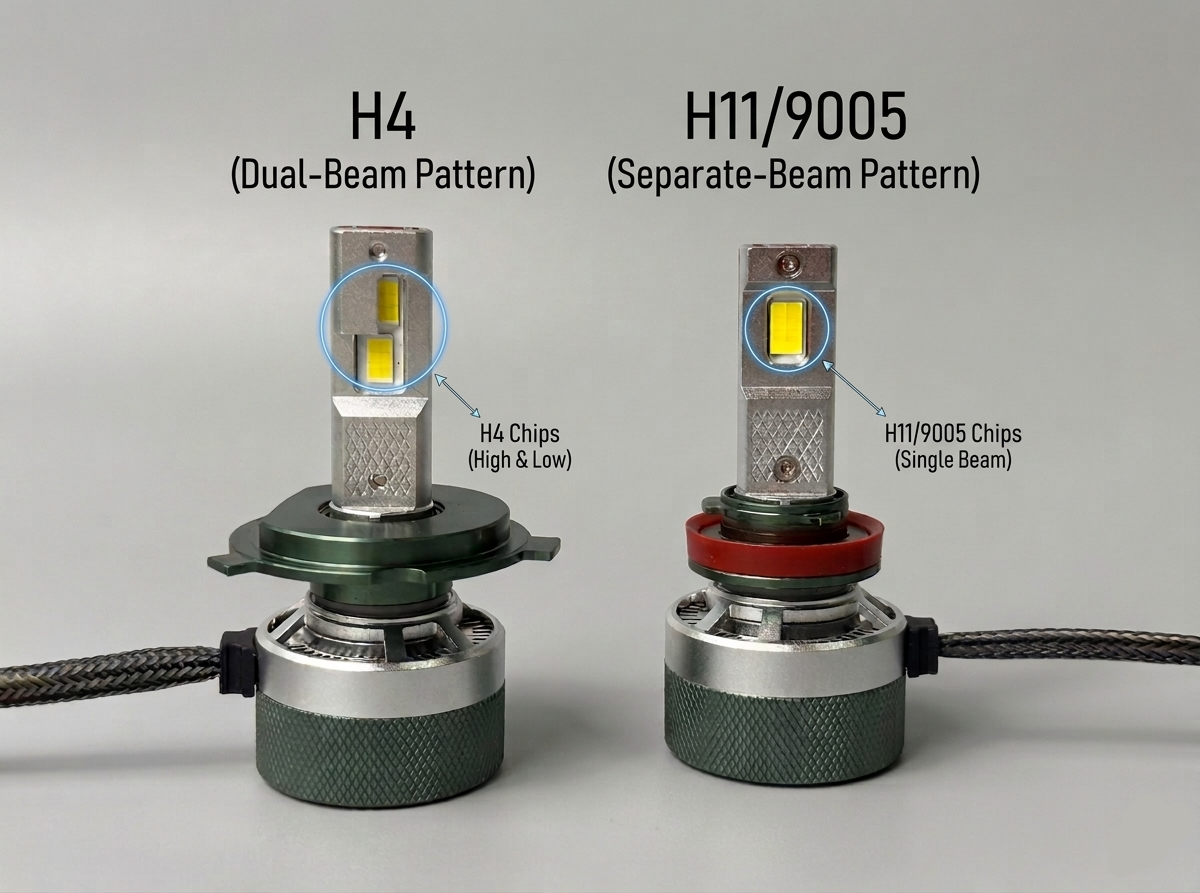
Dual-Beam vs Separate-Bulb Systems
| Item | Dual-beam system | Separate high/low beam system |
|---|---|---|
| How it works | One bulb or unit provides both low and high beam functions | Low beam and high beam use different bulbs or units |
| Typical advantage | Helps reduce SKU complexity | Allows each beam function to be optimized separately |
| Key sourcing concern | Beam switching, optical balance, heat control, fitment | Correct application mapping, SKU coverage, fitment |
For importers and distributors, understanding this difference is important for SKU planning, inventory efficiency, and accurate cataloging. A strong product range should align with actual vehicle applications, not just bulb popularity.
For workshop customers, correct application guidance is essential because installing the wrong type or assuming one bulb works for both beam positions can quickly lead to fitment issues or poor beam results.
Beam vs Bulb: Understanding the Difference
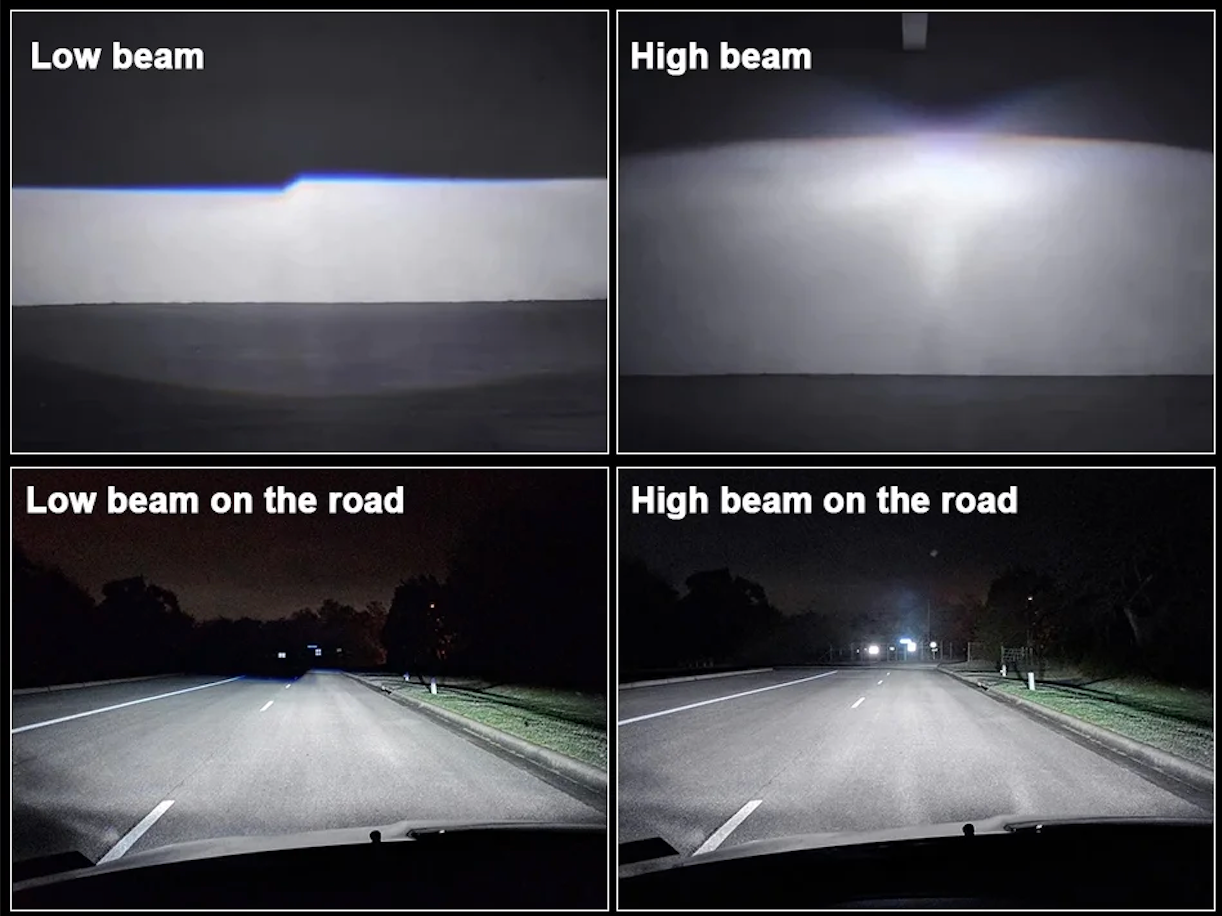
When it comes to car headlights, the terms “beam” and “bulb” are often confused, but they refer to two distinct aspects of your vehicle’s lighting system. Understanding this difference is key to choosing the right replacement parts and achieving the best lighting performance for your driving needs.
The “beam” refers to the pattern and direction of light produced by your headlights—specifically, whether you are using the high beam or low beam setting. High beam and low beam each create a different spread of light, tailored for different driving conditions. High beams produce a focused, long-range light for maximum visibility on dark, empty roads, while low beams offer a wider, shorter-range light designed to minimize glare for oncoming drivers and vehicles ahead.
The “bulb,” on the other hand, is the actual light source inside the headlight assembly. Modern vehicles may use halogen, HID, or increasingly, LED headlight bulbs. LED bulbs are especially popular for their brightness, energy efficiency, and long lifespan. When upgrading or replacing your headlights, it’s important to select the correct bulb type for your vehicle and intended use.
Some vehicles use separate bulbs for high and low beams, while others use dual beam bulbs. Dual beam bulbs, such as those with two filaments, can switch between high and low beam functions within the same bulb, offering convenience and simplifying replacement. LED headlight bulbs are available in both single-beam and dual-beam designs, allowing you to match your vehicle’s requirements and upgrade your lighting system for better performance.
Why Beam Pattern Matters More Than Brightness Claims
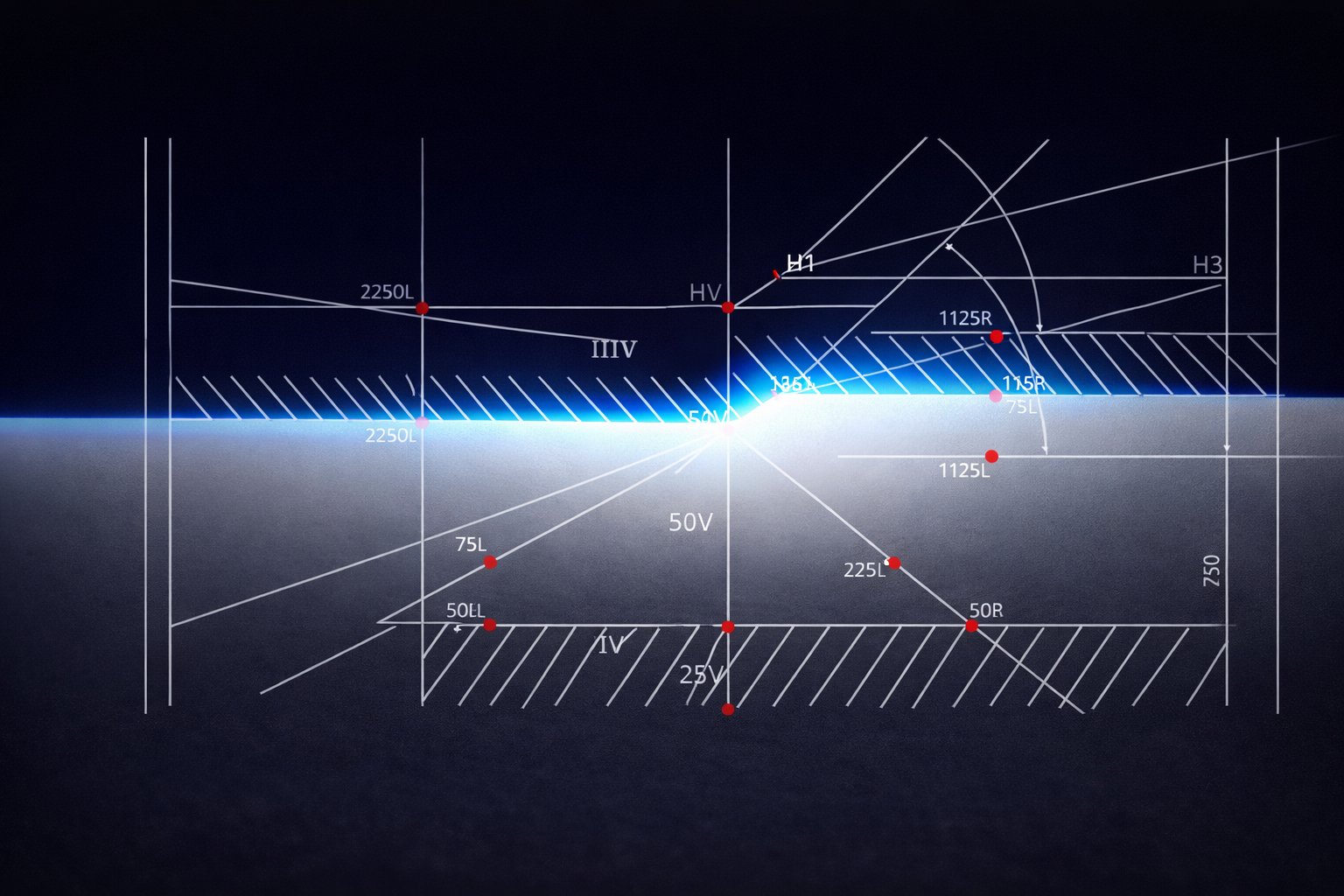
One of the most common mistakes in the headlight bulb market is treating lumen claims as the main measure of performance.
In real driving, the driver does not benefit from total raw output alone. What matters is how much useful light reaches the road in the right places without causing glare.
An LED bulb with poor emitter geometry, unstable thermal behavior, or weak optical compatibility may claim high output but still perform worse on the road. It may produce too much foreground light, too much upward scatter, poor cutoff, or an unfocused hotspot.
A better product is one that delivers:
- cleaner beam shape
- more stable cutoff
- better useful distance
- lower glare risk
- more consistent output over time
For B2B buyers, this is where supplier capability matters. A reliable partner should be able to support not only product supply, but also application understanding, beam performance logic, fitment range planning, and quality consistency.
At our side, we focus on LED automotive lighting solutions with practical attention to beam control, compact fitment, thermal structure, and product consistency. For customers building product lines for retail, wholesale, workshop supply, or private label channels, this helps improve market fit and reduce mismatch risk.
Common Myths and FAQ
Myth: High beams always improve safety
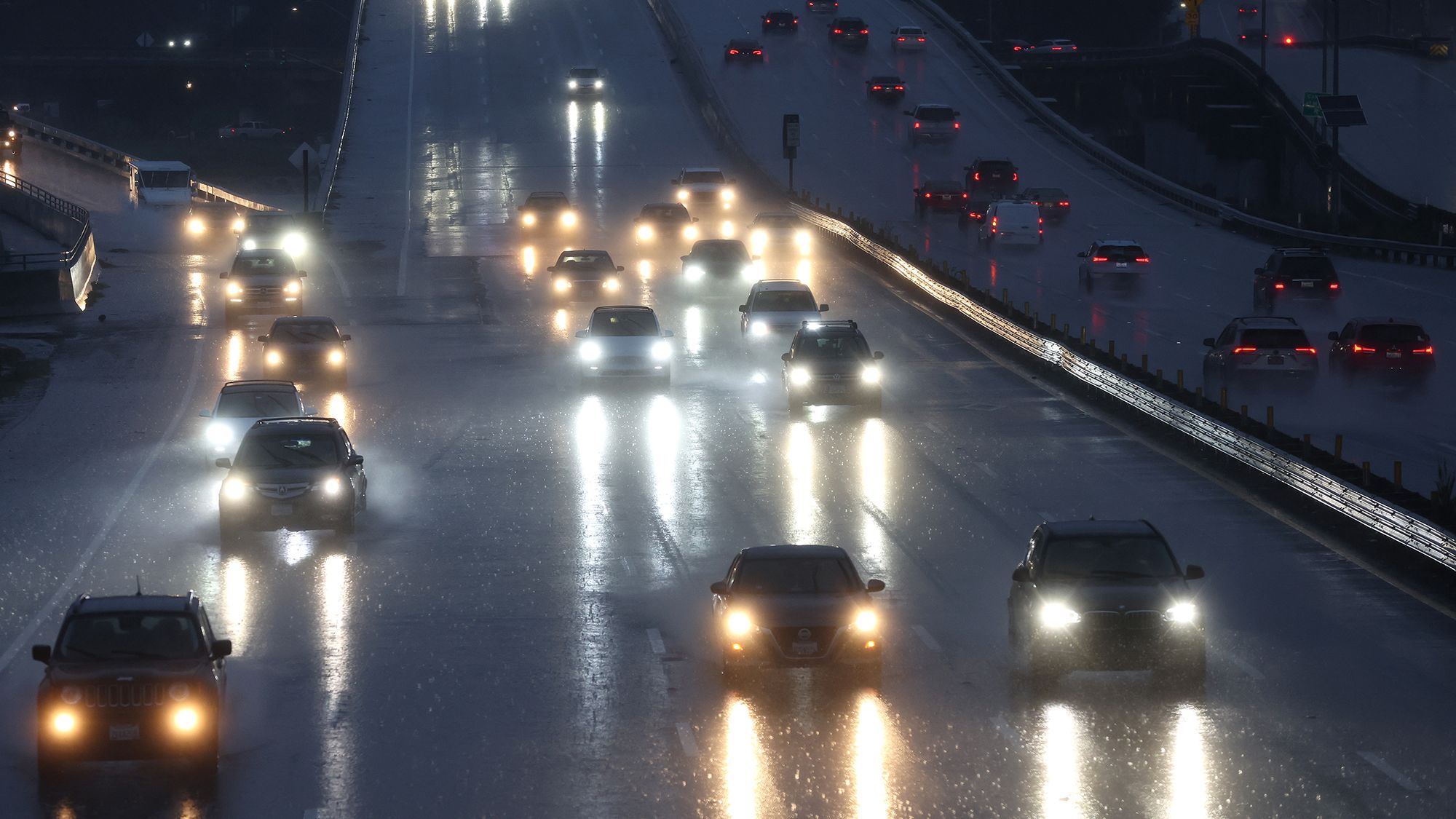
Not always. On dark roads with no traffic, they can help. In fog, rain, snow, or traffic, they can create glare and actually reduce visibility.
Myth: Any LED bulb is automatically better than halogen
Not necessarily. A poorly designed LED retrofit can produce a worse beam pattern, more glare, and lower usable visibility than a good halogen setup.
Myth: Fog lights can replace headlights
No. Fog lights are auxiliary lights designed for specific low-visibility conditions. They are not intended to replace standard low beams.
Myth: More lumens always mean better performance
Real road performance depends on beam pattern, optical match, thermal stability, and correct installation, not just output claims.
FAQ: Do high beams and low beams always use the same bulb?
No. Some vehicles use separate bulbs, while others use dual-beam bulbs such as H4.
FAQ: Can LED bulbs be used in any housing?
Not always. Compatibility depends on bulb size, emitter layout, thermal design, and how well the bulb matches the reflector or projector housing.
Conclusion
Low beams and high beams serve different functions, and using the correct one depends on traffic, weather, road type, and visibility needs.
From a product and sourcing perspective, the topic goes beyond simple usage. It also highlights why beam pattern, compatibility, thermal design, and fitment matter so much in headlight bulb selection. For aftermarket buyers, importers, distributors, and private label brands, the best LED headlight solution is not the one with the highest claim on paper. It is the one that delivers usable beam performance, stable quality, and reliable market fit.
If you are looking for LED headlight bulbs for distribution, private label, or workshop supply, we would be glad to discuss your market needs, target fitments, and product positioning. Contact us to explore the right LED lighting solution for your business.