
In B2B automotive lighting projects, “customization” is often misunderstood as simply changing power or appearance.
In reality, a successful LED lighting project requires a structured engineering process that balances optical performance, thermal reliability, regulatory compliance, and manufacturability.
A typical custom LED lighting development starts with application definition.
This includes vehicle type, installation position, operating voltage, usage environment, and target market regulations. For example, lighting solutions for Japan usually require stricter control on beam pattern stability, glare limitation, and long term thermal aging performance.
The second stage is optical and thermal feasibility evaluation.
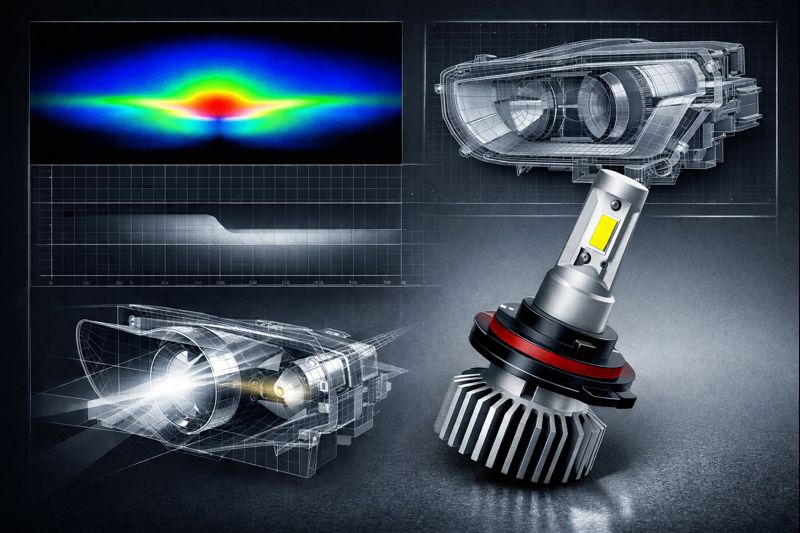
Based on the defined requirements, optical simulation and thermal structure concepts are proposed. Key parameters such as beam angle, cutoff behavior, lumen maintenance, junction temperature, and housing material are evaluated before physical samples are made.
After feasibility confirmation, prototype development and testing begin.
Samples are produced to validate optical distribution, temperature rise, vibration resistance, and electrical stability. This stage is critical for detecting potential risks before moving into tooling or mass production.
The final step is production readiness and consistency control.
For B2B customers, consistency is often more important than peak performance. Stable component sourcing, standardized processes, and repeatable testing methods ensure that every batch meets the same performance standard.
Customization in automotive LED lighting is not about complexity.
It is about making the product reliable, compliant, and scalable for long term supply.